
- Active ingredients
- Dosage form
- Nasal spray
- Route
- Nasal
- Care area
- Drug class
- Other, Vitamin / Nutrient
- DEA schedule
- Non-controlled


Compounded and dispensed by an NABP-accredited, LegitScript-certified pharmacy. Verify accreditation (opens in a new tab)
About compounded medications
All formulations are patient-specific prescriptions compounded by Lake Hills Pharmacy under FDA section 503A. Individual ingredients are FDA-approved; compounded products are not reviewed by the FDA for safety, effectiveness, or quality. For licensed healthcare providers only.
Available Dosage Strengths
Nasal spray
10%
Unit size: 6 mL
Clinical information
Product Overview
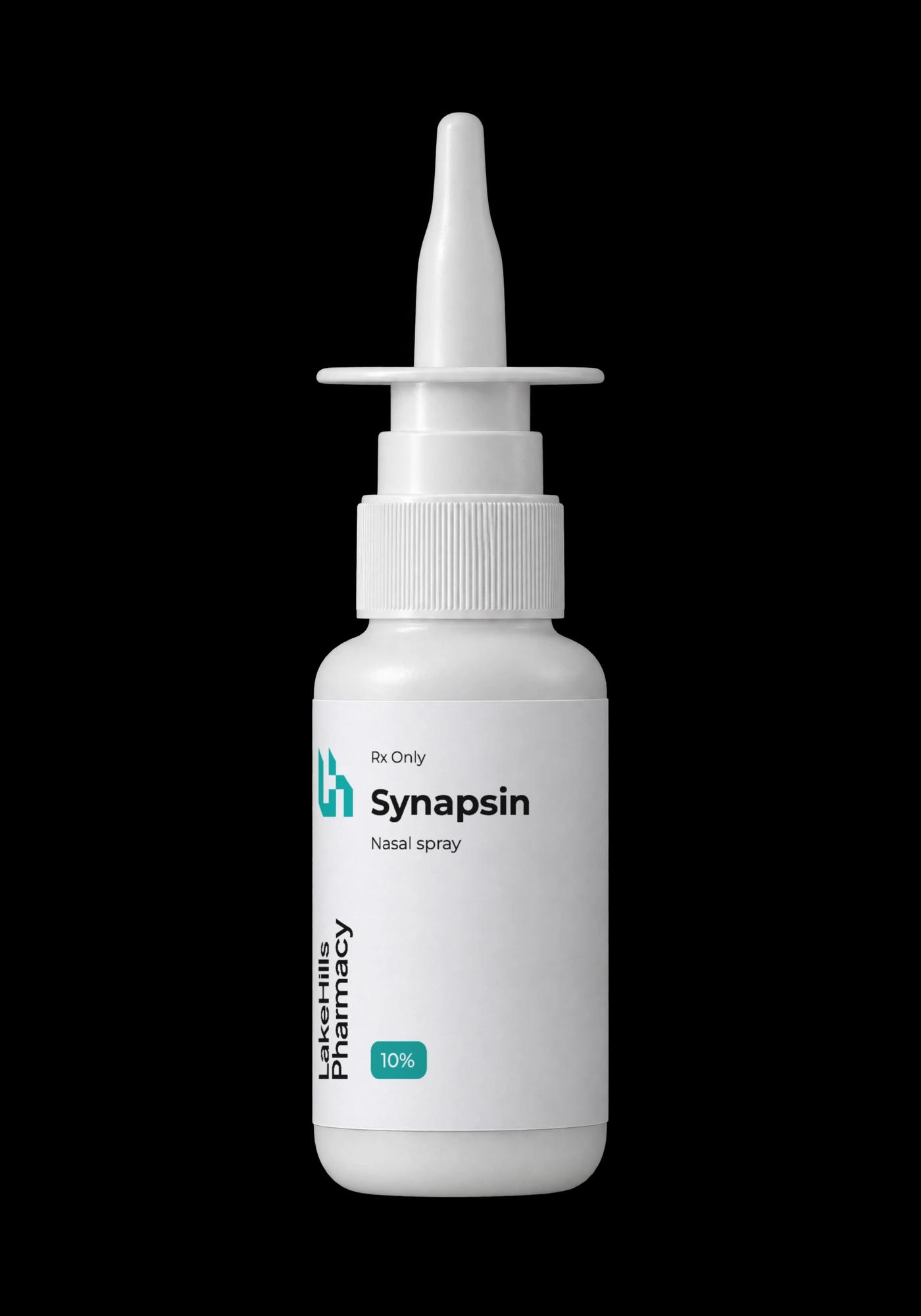
Synapsin® (ginsenoside Rg3 / nicotinamide riboside) nasal spray, a PCCA formula compounded by Lake Hills Pharmacy. Synapsin® is a registered trademark of its owner; the formula is credited to PCCA.
Lake Hills Pharmacy compounds this nonsterile intranasal spray as a 503A pharmacy, pursuant to a patient-specific prescription. Ginsenoside Rg3 is a saponin from processed Panax ginseng, and nicotinamide riboside is a form of vitamin B3 that serves as a precursor of NAD+. Neither active is in an FDA-approved drug product, and no FDA-labeled indication or dose exists. Prescribers use this preparation in cognitive-health care.
Active Ingredients & Strengths
- Active ingredients: ginsenoside Rg3 and nicotinamide riboside.
- Listed as 10%, 6 mL nasal spray bottle; the concentration of each active follows the PCCA Synapsin® formula and the prescription label.
- Route: nasal.
Dosing & Administration
No FDA-labeled dose exists for this route; dosing is individualized by the prescriber. Use as prescribed. Intranasal absorption and brain exposure of these actives have not been established in humans.
Key Safety Information
- Do not use with known allergy to ginseng, nicotinamide riboside or any ingredient of the spray, or with active nasal infection unless the prescriber directs.
- Ginsenosides have antiplatelet activity in laboratory studies, and ginseng has been associated with altered INR in patients taking warfarin. Use caution with anticoagulants and antiplatelet drugs.
- Ginseng has been reported to interact with MAO inhibitors such as phenelzine, and may lower blood glucose, so use caution with antidiabetic drugs.
- Expected adverse effects are nasal irritation, dryness, congestion, headache and dizziness. Ginseng taken orally has also been associated with insomnia and nervousness.
- Safety in pregnancy, breastfeeding and children has not been established; use is not recommended in these groups.
Storage, Stability & BUD
- Storage: per the prescription label.
- Beyond-use date: per the prescription label.
- USP default BUD (USP <795>): 35 days at controlled room temperature or refrigerated for a preserved aqueous preparation, 14 days refrigerated for a nonpreserved aqueous preparation, or 90 days for a nonaqueous preparation; the category follows the Lake Hills base and vehicle.
- Lake Hills may assign extended dating based on its own stability data.
Patient Counseling
- Use this medication exactly as your prescriber directs. Do not change the amount or how often you use it without talking to your prescriber.
- Gently blow your nose before use. Keep the tip clean and do not share the bottle.
- Store the bottle as the label directs.
- Tell your prescriber if you take blood thinners, antidepressants or diabetes medicines, or if you are pregnant or breastfeeding.
- Stop using the spray and contact your prescriber for nosebleeds, persistent nasal irritation, a rash or any new neurologic symptom.
References
- Natural Medicines Comprehensive Database: Panax ginseng; Nicotinamide riboside.
- USP General Chapter <795> Pharmaceutical Compounding, Nonsterile Preparations.
Active ingredients
Ginsenoside Rg3
Overview
Ginsenoside Rg3 is a protopanaxadiol-type triterpene saponin found mainly in heat-processed (red) Panax ginseng. It exists as 20(S) and 20(R) epimers. Ginsenoside Rg3 is a bulk substance with no FDA-approved drug product in the United States, and no FDA-labeled indication or dose exists. Ginseng extracts containing it are sold as dietary supplements. It is used in compounded preparations, including in combination with nicotinamide riboside in a nasal spray.
Indications & Uses
- No FDA-labeled indication exists. Prescribers use compounded preparations containing ginsenoside Rg3 in cognitive-health care. Human clinical data for ginsenoside Rg3 as a single agent, and for intranasal use, are limited.
Mechanism of Action
In laboratory and animal studies, ginsenoside Rg3 has anti-inflammatory and antioxidant actions, including reduced NF-kappa-B signaling and modulation of microglial activation. It has also been reported to modulate voltage-gated ion channels and NMDA receptors and to inhibit platelet aggregation. The relevance of these findings to human use has not been established.
Pharmacokinetics
Oral bioavailability of ginsenoside Rg3 is very low. In the gut it is deglycosylated by intestinal bacteria to ginsenoside Rh2 and protopanaxadiol, which are absorbed to a greater extent. Elimination is mainly biliary. Human pharmacokinetic data are limited, and absorption and brain exposure after intranasal administration have not been established in humans.
Contraindications
- Known hypersensitivity to ginseng, ginsenosides or any ingredient of the preparation.
Warnings & Precautions
- Bleeding risk: ginsenosides inhibit platelet aggregation in vitro. Use caution in patients with bleeding disorders and before surgery.
- Ginseng may lower blood glucose; use caution in patients with diabetes. Ginseng has been associated with blood pressure changes, insomnia and nervousness, and rarely with mania, particularly with MAO inhibitors.
- Some ginseng constituents have estrogen-like activity in laboratory studies; use caution in hormone-sensitive conditions. With intranasal use, avoid application to damaged nasal mucosa.
Drug Interactions
- Warfarin: ginseng has been associated with altered INR, including reduced warfarin response with American ginseng. Monitor INR.
- Antiplatelet drugs and anticoagulants: possible additive bleeding risk.
- MAO inhibitors (for example phenelzine): case reports of headache, tremor and manic symptoms with ginseng.
- Antidiabetic drugs and insulin: possible additive glucose lowering.
Adverse Effects
Data are drawn mainly from oral ginseng products. Reported effects include insomnia, nervousness, headache, gastrointestinal upset, and blood pressure changes; breast tenderness and vaginal bleeding have been reported rarely. With intranasal use, nasal irritation, dryness and congestion are expected. Allergic reactions are possible.
Pregnancy & Lactation
Safety in pregnancy and lactation has not been established. Ginsenoside Rb1, a related ginsenoside, showed teratogenic effects in an animal embryo model. Use during pregnancy and breastfeeding is not recommended.
Monitoring
Monitor clinical response and tolerability, INR in patients taking warfarin, blood glucose in patients with diabetes, blood pressure, and signs of bleeding. With nasal use, monitor for local irritation or epistaxis.
References
- Natural Medicines Comprehensive Database: Panax ginseng.
- USP General Chapter <795> Pharmaceutical Compounding, Nonsterile Preparations.
Nicotinamide Riboside
Vitamin / Nutrient
Overview
Nicotinamide riboside (NR) is a pyridine-nucleoside form of vitamin B3 and a precursor of nicotinamide adenine dinucleotide (NAD+). It is sold in the United States as a dietary supplement ingredient, usually as nicotinamide riboside chloride. NR is a bulk substance with no FDA-approved drug product, and no FDA-labeled indication or dose exists. It is used in compounded oral capsules and, in combination with ginsenoside Rg3, in a nasal spray.
Indications & Uses
- No FDA-labeled indication exists. Prescribers use compounded preparations of nicotinamide riboside to support NAD+ levels, including in cognitive-health and healthy-aging care. Human studies have mainly examined oral NR and its effect on blood NAD+ levels.
Mechanism of Action
NR enters cells through nucleoside transporters and is phosphorylated by nicotinamide riboside kinases (NRK1 and NRK2) to nicotinamide mononucleotide (NMN), which is converted to NAD+. NAD+ is a coenzyme in cellular redox reactions and a substrate for sirtuins, PARPs and CD38. NR does not act on the niacin receptor GPR109A and is not associated with niacin-type flushing.
Pharmacokinetics
After oral administration, NR raises blood NAD+ in a dose-dependent manner in human studies. Much of an oral dose is converted to nicotinamide in the gut and liver before reaching the circulation. Metabolites, including N-methylnicotinamide and its pyridone derivatives, are excreted in the urine. The plasma half-life of NR itself is short. Absorption after intranasal administration has not been established in humans.
Contraindications
- Known hypersensitivity to nicotinamide riboside or any ingredient of the preparation.
Warnings & Precautions
- Long-term safety beyond the durations studied in human trials, generally up to several months, has not been established.
- Very high doses of nicotinamide, a major metabolite, have been associated with liver toxicity; use caution in patients with liver disease and when combining with other vitamin B3 products.
- With intranasal use, avoid application to damaged nasal mucosa.
Drug Interactions
- No clinically significant drug interactions have been established. Additive exposure may occur with niacin, nicotinamide or other NAD+ precursors. Theoretical interactions with drugs that depend on NAD+-consuming pathways have not been characterized in humans.
Adverse Effects
In human studies of oral NR, adverse effects were generally mild and similar to placebo, and included nausea, fatigue, headache, diarrhea, abdominal discomfort and indigestion. With intranasal use, nasal irritation, dryness and congestion are expected. Allergic reactions are possible.
Pregnancy & Lactation
Safety of NR in pregnancy and lactation has not been established. Vitamin B3 is required in pregnancy, but supplemental NR beyond dietary intake is not recommended during pregnancy or breastfeeding unless the prescriber directs.
Monitoring
Monitor clinical response and tolerability. Consider liver function testing in patients with liver disease or those using high doses or multiple vitamin B3 products. With nasal use, monitor for local irritation.
References
- Natural Medicines Comprehensive Database: Nicotinamide riboside.
- Institute of Medicine, Dietary Reference Intakes for Thiamin, Riboflavin, Niacin, Vitamin B6, Folate, Vitamin B12, Pantothenic Acid, Biotin, and Choline.
- USP General Chapter <795> Pharmaceutical Compounding, Nonsterile Preparations.
Ask a pharmacist
Are compounded medications FDA approved?
All formulations are patient-specific prescriptions compounded by Lake Hills Pharmacy under FDA section 503A. Individual ingredients are FDA-approved; compounded products are not reviewed by the FDA for safety, effectiveness, or quality. For licensed healthcare providers only.
How do I get a prescription filled here?
You can have your doctor send prescriptions to us any time. We also transfer your medications from another pharmacy. Our pharmacy accepts all major insurance plans.
Can you ship this medication to my state?
It depends on the medication and on your state. Whether we can dispense or ship a medication to you depends on the laws and board of pharmacy rules of your state and on our licensure there. We confirm availability when we receive a prescription.
These answers cover the basics. For anything about a formula, a strength or a prescription, contact our pharmacists.
Mon - Fri: 8:30am - 6:30pm CTSaturday: 9:00am - 2:00pm CTSunday: Closed
12005 Bee Cave Rd, Suite 1-A, Austin, TX 78738