
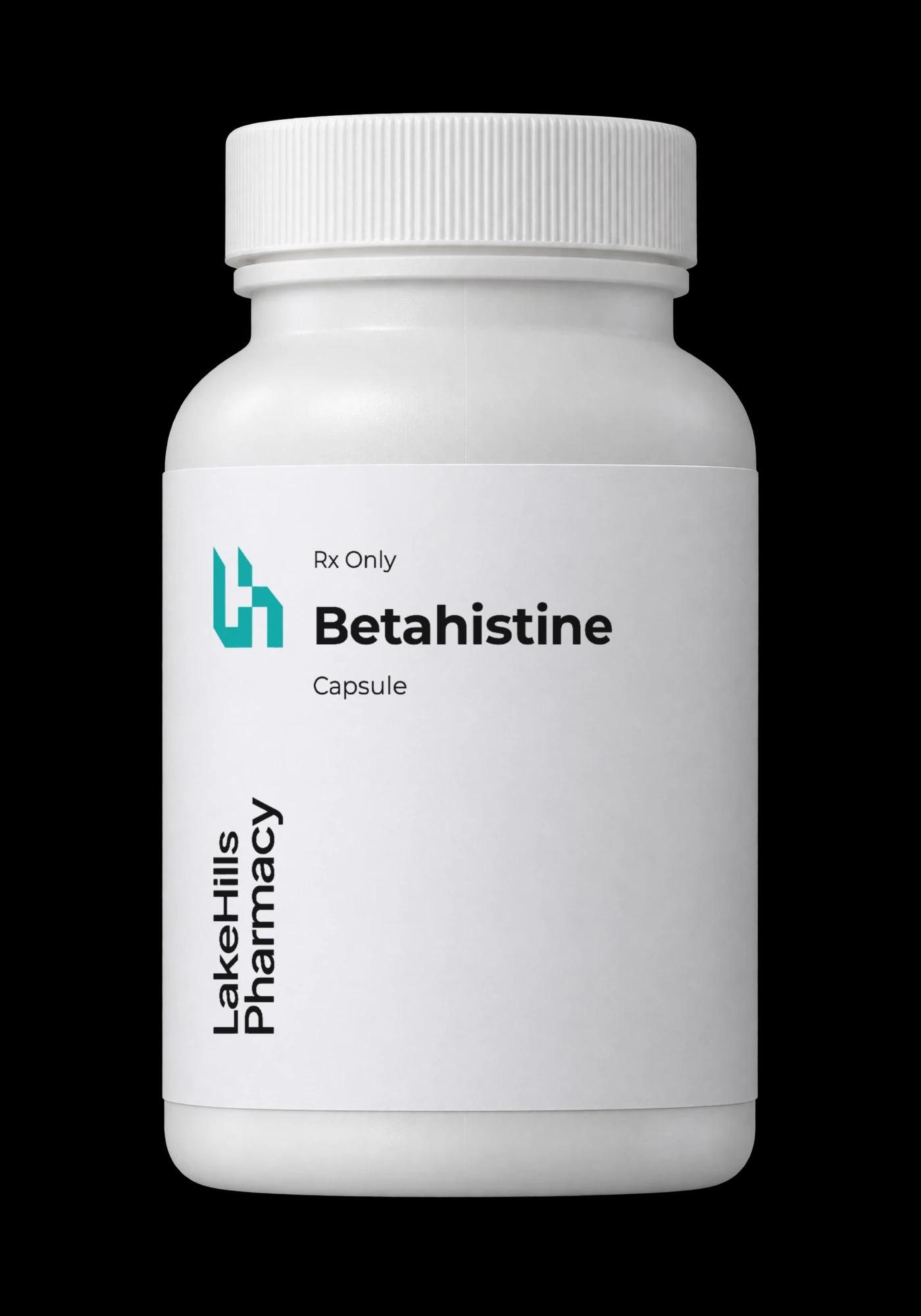
- Active ingredients
- Dosage form
- Capsule
- Route
- Oral
- Care area
- Drug class
- Other
- DEA schedule
- Non-controlled
- Storage
- Room temperature


Compounded and dispensed by an NABP-accredited, LegitScript-certified pharmacy. Verify accreditation (opens in a new tab)
About compounded medications
All formulations are patient-specific prescriptions compounded by Lake Hills Pharmacy under FDA section 503A. Individual ingredients are FDA-approved; compounded products are not reviewed by the FDA for safety, effectiveness, or quality. For licensed healthcare providers only.
Available Dosage Strengths
Capsule
12 mg
16 mg
24 mg
Clinical information
Product Overview
Betahistine Capsules are nonsterile oral capsules of betahistine, a histamine analog, that Lake Hills Pharmacy compounds as a 503A pharmacy, pursuant to a patient-specific prescription. There is no FDA-approved betahistine product in the US. Outside the US, betahistine is licensed (for example, as Serc) for vertigo, tinnitus and hearing loss associated with Ménière's disease. Prescribers use compounded betahistine for Ménière's disease and other vestibular disorders.
Betahistine is a weak histamine H1 receptor agonist and a potent H3 receptor antagonist. It is thought to increase inner-ear microcirculation and to facilitate central vestibular compensation. Evidence from controlled trials is mixed, and the largest placebo-controlled trial did not show a difference in attack frequency.
Active Ingredients & Strengths
- Betahistine 12 mg capsule (container size not listed in the Lake Hills record).
- Betahistine 16 mg capsule (container size not listed in the Lake Hills record).
- Betahistine 24 mg capsule (container size not listed in the Lake Hills record).
Dosing & Administration
Oral, as prescribed. No FDA-labeled dose exists for this route; dosing is individualized by the prescriber. Non-US labeling advises taking betahistine with food to limit gastrointestinal upset.
Key Safety Information
- No US label or boxed warning. Contraindicated with hypersensitivity to betahistine or any capsule ingredient and in pheochromocytoma.
- Use caution in bronchial asthma and in patients with a history of peptic ulcer.
- Interactions: monoamine oxidase inhibitors, including MAO-B inhibitors such as selegiline, can raise betahistine exposure; H1 antihistamines may oppose its effect.
- Common adverse effects are nausea, indigestion and headache. Hypersensitivity reactions, including rash, itching, hives and angioedema, have been reported.
- Pregnancy and lactation: data are insufficient; avoid unless the prescriber judges use clearly necessary. Not recommended for children.
Storage, Stability & BUD
Storage: room temperature, in a tightly closed container protected from light and moisture.
Beyond-use date: per the prescription label.
USP default BUD for this dosage form: 180 days at controlled room temperature (nonsterile solid oral dosage form, USP <795>).
Lake Hills may assign extended dating based on its own stability data.
Patient Counseling
Take the capsules exactly as the prescriber directs. Do not change the dose or stop without talking to the prescriber.
Report rash, itching, swelling of the face or throat, wheezing or stomach pain.
Tell the prescriber about all other medicines, especially antihistamines and MAO inhibitors, and if you are pregnant or breastfeeding.
References
- Serc (betahistine dihydrochloride) Summary of Product Characteristics (non-US label).
- Clinical Practice Guideline: Ménière's Disease (2020), American Academy of Otolaryngology–Head and Neck Surgery Foundation.
- Martindale: The Complete Drug Reference, betahistine monograph.
- USP General Chapter <795> Pharmaceutical Compounding — Nonsterile Preparations.
Active ingredients
Betahistine
Overview
Betahistine is a structural analog of histamine, used as the dihydrochloride or mesilate salt. There is no FDA-approved betahistine product in the US. It is licensed in many other countries, for example as Serc. Lake Hills Pharmacy uses betahistine bulk drug substance in compounded oral capsules.
Indications & Uses
No FDA-labeled indication or dose exists. Outside the US, betahistine is licensed for vertigo, tinnitus and hearing loss associated with Ménière's disease. Prescribers in the US use compounded betahistine for Ménière's disease and other vestibular disorders.
Evidence is mixed: a Cochrane review rated the available evidence as low quality, and the largest placebo-controlled trial (BEMED, 2016) found no difference in attack frequency compared with placebo. The 2020 AAO-HNS guideline lists betahistine among options a clinician may offer for maintenance therapy.
Mechanism of Action
Betahistine is a weak partial agonist at histamine H1 receptors and a potent antagonist (inverse agonist) at H3 receptors, with negligible H2 activity. H3 blockade increases histamine synthesis and release, which is thought to increase cochlear and vestibular microcirculation, reduce firing in the vestibular nuclei and facilitate central vestibular compensation.
Pharmacokinetics
Betahistine is rapidly and almost completely absorbed but undergoes extensive first-pass metabolism, mainly by monoamine oxidase, to the inactive metabolite 2-pyridylacetic acid, so plasma levels of the parent drug are very low. The metabolite peaks about 1 hour after dosing and has a half-life of about 3.5 hours. Elimination is almost entirely urinary within 24 hours. Food lowers peak levels without changing the extent of absorption.
Contraindications
- Hypersensitivity to betahistine or any component.
- Pheochromocytoma.
Warnings & Precautions
- Bronchial asthma: monitor patients with asthma during treatment.
- History of peptic ulcer: use with caution, as gastrointestinal effects can occur.
- Not recommended for children and adolescents because data are insufficient.
- Hypersensitivity reactions, including skin reactions and angioedema, require stopping the drug.
Drug Interactions
- Monoamine oxidase inhibitors, including MAO-B selective agents such as selegiline: inhibit betahistine metabolism and can increase exposure.
- H1 antihistamines: may in theory reduce the effect of betahistine, and betahistine may reduce the effect of antihistamines.
Adverse Effects
Common: nausea, dyspepsia and headache. Others: vomiting, abdominal pain, bloating and mild gastrointestinal discomfort, often reduced by taking it with food. Hypersensitivity reactions, including anaphylaxis, rash, pruritus, urticaria and angioedema, have been reported.
Pregnancy & Lactation
Data on use in pregnancy are insufficient; avoid unless clearly necessary. Whether betahistine is excreted in human milk is unknown; the prescriber weighs the benefit of breastfeeding against the benefit of therapy.
Monitoring
Frequency and severity of vertigo episodes, hearing and tinnitus as assessed by the prescriber, gastrointestinal tolerability, asthma symptoms in patients with asthma, and signs of hypersensitivity.
References
- Serc (betahistine dihydrochloride) Summary of Product Characteristics (non-US label).
- Clinical Practice Guideline: Ménière's Disease (2020), American Academy of Otolaryngology–Head and Neck Surgery Foundation.
- Murdin L, Hussain K, Schilder AGM. Betahistine for symptoms of vertigo. Cochrane Database of Systematic Reviews, 2016.
- Martindale: The Complete Drug Reference, betahistine monograph.
Ask a pharmacist
Are compounded medications FDA approved?
All formulations are patient-specific prescriptions compounded by Lake Hills Pharmacy under FDA section 503A. Individual ingredients are FDA-approved; compounded products are not reviewed by the FDA for safety, effectiveness, or quality. For licensed healthcare providers only.
How do I get a prescription filled here?
You can have your doctor send prescriptions to us any time. We also transfer your medications from another pharmacy. Our pharmacy accepts all major insurance plans.
Can you ship this medication to my state?
It depends on the medication and on your state. Whether we can dispense or ship a medication to you depends on the laws and board of pharmacy rules of your state and on our licensure there. We confirm availability when we receive a prescription.
These answers cover the basics. For anything about a formula, a strength or a prescription, contact our pharmacists.
Mon - Fri: 8:30am - 6:30pm CTSaturday: 9:00am - 2:00pm CTSunday: Closed
12005 Bee Cave Rd, Suite 1-A, Austin, TX 78738