
- Active ingredients
- Dosage form
- Injection
- Route
- Intramuscular injection
- Care area
- Drug class
- Vitamin / Nutrient
- DEA schedule
- Non-controlled
- Sterile preparation
- Yes


Compounded and dispensed by an NABP-accredited, LegitScript-certified pharmacy. Verify accreditation (opens in a new tab)
About compounded medications
All formulations are patient-specific prescriptions compounded by Lake Hills Pharmacy under FDA section 503A. Individual ingredients are FDA-approved; compounded products are not reviewed by the FDA for safety, effectiveness, or quality. For licensed healthcare providers only.
Available Dosage Strengths
Injection
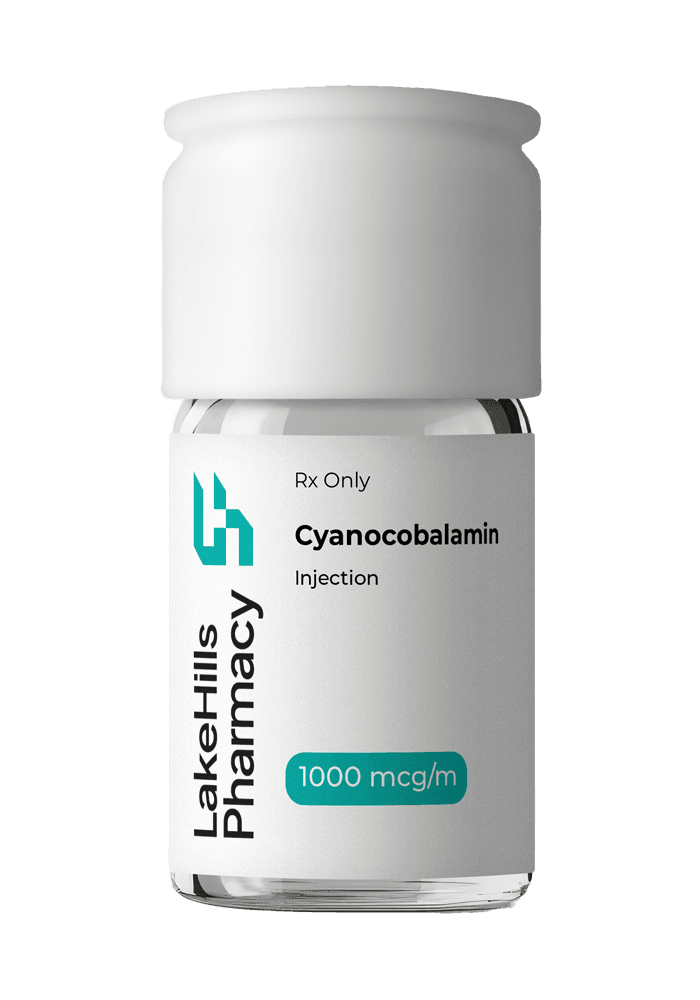
1000 mcg/
mL
Clinical information
Product Overview
Cyanocobalamin (Vitamin B12) Injection is a sterile injectable solution for intramuscular use, compounded by Lake Hills Pharmacy, a 503A pharmacy, pursuant to a patient-specific prescription. Cyanocobalamin is a synthetic form of vitamin B12.
FDA-approved Cyanocobalamin Injection, USP is indicated for vitamin B12 deficiency due to malabsorption, such as pernicious anemia, gastrointestinal disease, gastric or ileal resection, small-bowel bacterial overgrowth and fish tapeworm infestation, and where requirements are increased and oral therapy is not feasible. Prescribers use compounded cyanocobalamin injection to treat or prevent vitamin B12 deficiency when injection is preferred.
Active Ingredients & Strengths
Active ingredient: cyanocobalamin, in a sterile aqueous solution.
Available strength: 1,000 mcg/mL. The vial size is stated on the prescription label.
Dosing & Administration
Route: intramuscular. Use as prescribed. The FDA-approved injection is labeled for intramuscular or deep subcutaneous use; this preparation is listed for intramuscular use.
FDA labeling for pernicious anemia gives 100 mcg per injection, with monthly 100 mcg maintenance injections continued for life after initial repletion. The label notes that much of any single dose above 100 mcg is excreted in the urine. Doses and intervals for other indications are individualized by the prescriber.
Key Safety Information
- Contraindicated with hypersensitivity to cobalt or vitamin B12. Anaphylaxis is rare; the label recommends an intradermal test dose in patients suspected of sensitivity.
- Severe megaloblastic anemia: hypokalemia and sudden death can occur early in treatment; monitor potassium. Treatment can unmask polycythemia vera.
- Patients with early Leber's disease (hereditary optic nerve atrophy) have developed severe and rapid optic atrophy with vitamin B12; it should not be used in these patients.
- Folic acid can correct the anemia of B12 deficiency while neurologic damage progresses. Chloramphenicol may blunt the hematologic response.
- Injectable vitamin products may contain aluminum, which can accumulate with impaired kidney function, and benzyl alcohol, which is linked to gasping syndrome in premature infants; check the label for excipients. If the vial contains benzyl alcohol, it is not for use in neonates.
Storage, Stability & BUD
Storage: controlled room temperature, 20 to 25 °C (68 to 77 °F), protected from light.
Beyond-use date: per the prescription label.
USP default BUD (USP <797>, Category 2, no sterility testing): 1 day at room temperature, 4 days refrigerated or 45 days frozen when prepared from one or more nonsterile starting components; 4, 10 or 45 days when prepared only from sterile starting components. Longer USP dating applies after terminal sterilization or a passing sterility test.
Lake Hills may assign extended dating based on its own stability data.
If supplied as a preserved multiple-dose vial, follow the prescription label for in-use dating after first puncture.
Patient Counseling
- Use cyanocobalamin injection exactly as your prescriber directs. It is given into a muscle.
- Get medical help right away for hives, swelling of the face or throat, wheezing or trouble breathing.
- Mild pain at the injection site, mild diarrhea or itching can occur.
- Tell your prescriber about all medicines and supplements you take, including folic acid, and keep your laboratory appointments.
- Store the vial as the label directs, protect it from light, and do not use it after the beyond-use date or the in-use date on the label.
References
- Cyanocobalamin Injection, USP Prescribing Information.
- USP General Chapter <797> Pharmaceutical Compounding: Sterile Preparations.
Active ingredients
Cyanocobalamin
Vitamin / Nutrient
Overview
Cyanocobalamin is a synthetic, water-soluble form of vitamin B12. It is FDA approved as Cyanocobalamin Injection, USP for intramuscular or deep subcutaneous use, and as a nasal spray (Nascobal) for maintenance therapy. Oral cyanocobalamin is widely available without a prescription. Compounded injections are made pursuant to patient-specific prescriptions.
Indications & Uses
FDA-labeled indications of the injection: vitamin B12 deficiency due to malabsorption, as in pernicious anemia, gastrointestinal pathology, dysfunction or surgery (including gluten enteropathy, sprue, small-bowel bacterial overgrowth and total or partial gastrectomy), fish tapeworm infestation, and malignancy of the pancreas or bowel; deficiency where requirements are increased and oral therapy is not feasible; and the Schilling test.
Prescribers also use cyanocobalamin to treat or prevent deficiency associated with metformin, long-term acid suppression, bariatric surgery or vegan diets.
Mechanism of Action
Cyanocobalamin is converted in tissues to the coenzymes methylcobalamin and adenosylcobalamin. Methylcobalamin is the cofactor for methionine synthase, which converts homocysteine to methionine and regenerates tetrahydrofolate needed for DNA synthesis. Adenosylcobalamin is the cofactor for methylmalonyl-CoA mutase, important for myelin integrity. Deficiency causes megaloblastic anemia and neurologic damage.
Pharmacokinetics
After intramuscular injection, absorption is rapid, with peak plasma levels within about 1 hour. Cobalamin binds transcobalamin II for tissue delivery and is stored mainly in the liver. The biological half-life is about 6 days, with liver stores persisting far longer (around 400 days). Within 48 hours of a 100 mcg or 1,000 mcg injection, 50% to 98% of the dose appears in the urine, most in the first 8 hours, because doses above binding capacity are excreted unchanged.
Contraindications
- Sensitivity to cobalt or vitamin B12, or any component of the formulation.
Warnings & Precautions
- Leber's disease: patients with early hereditary optic nerve atrophy have developed severe and rapid optic atrophy with vitamin B12.
- Hypokalemia and sudden death can occur early in treatment of severe megaloblastic anemia, as new red-cell production consumes potassium; monitor potassium.
- Treatment can unmask polycythemia vera.
- Folic acid can correct the hematologic findings of B12 deficiency while neurologic damage progresses; doses of folic acid above 0.1 mg daily may mask the diagnosis. B12 deficiency left untreated for more than 3 months may cause permanent spinal cord lesions.
- Anaphylaxis has been reported rarely; an intradermal test dose is recommended in patients suspected of sensitivity.
- Aluminum in parenteral products can accumulate to toxic levels with impaired kidney function, particularly in premature neonates.
- Benzyl alcohol, used as a preservative in some products, has been associated with fatal gasping syndrome in premature infants.
Drug Interactions
- Chloramphenicol may blunt the hematologic response to vitamin B12.
- Oral B12 absorption is reduced by colchicine, para-aminosalicylic acid, metformin, proton pump inhibitors and H2 blockers, and heavy alcohol use; these do not affect injected B12 but can cause the deficiency being treated.
- Most antibiotics, methotrexate and pyrimethamine invalidate microbiological assays of serum B12 and folate.
Adverse Effects
Injection-site pain, mild transient diarrhea, itching, transient rash and a feeling of swelling of the body. Rare: anaphylaxis, pulmonary edema and congestive heart failure early in treatment, peripheral vascular thrombosis, and polycythemia vera.
Pregnancy & Lactation
Vitamin B12 is an essential nutrient and requirements rise in pregnancy; adequate intake is recommended, and deficiency should be treated. Vitamin B12 passes into breast milk and is compatible with breastfeeding; maternal deficiency can cause deficiency in the nursing infant.
Monitoring
Hematocrit, reticulocyte count, serum B12, folate and iron before treatment; in megaloblastic anemia, potassium and platelets during the first days of treatment and hematologic response over the first weeks; periodic serum B12 and complete blood count during maintenance; and neurologic status. Methylmalonic acid and homocysteine can support the diagnosis.
References
- Cyanocobalamin Injection, USP Prescribing Information.
- Nascobal (cyanocobalamin) nasal spray Prescribing Information.
- USP General Chapter <797> Pharmaceutical Compounding: Sterile Preparations.
Ask a pharmacist
Are compounded medications FDA approved?
All formulations are patient-specific prescriptions compounded by Lake Hills Pharmacy under FDA section 503A. Individual ingredients are FDA-approved; compounded products are not reviewed by the FDA for safety, effectiveness, or quality. For licensed healthcare providers only.
How do I get a prescription filled here?
You can have your doctor send prescriptions to us any time. We also transfer your medications from another pharmacy. Our pharmacy accepts all major insurance plans.
Can you ship this medication to my state?
It depends on the medication and on your state. Whether we can dispense or ship a medication to you depends on the laws and board of pharmacy rules of your state and on our licensure there. We confirm availability when we receive a prescription.
These answers cover the basics. For anything about a formula, a strength or a prescription, contact our pharmacists.
Mon - Fri: 8:30am - 6:30pm CTSaturday: 9:00am - 2:00pm CTSunday: Closed
12005 Bee Cave Rd, Suite 1-A, Austin, TX 78738