
- Active ingredients
- Dosage form
- Injection
- Route
- Intramuscular injection, Intravenous
- Care area
- Drug class
- Antioxidant
- DEA schedule
- Non-controlled
- Sterile preparation
- Yes


Compounded and dispensed by an NABP-accredited, LegitScript-certified pharmacy. Verify accreditation (opens in a new tab)
About compounded medications
All formulations are patient-specific prescriptions compounded by Lake Hills Pharmacy under FDA section 503A. Individual ingredients are FDA-approved; compounded products are not reviewed by the FDA for safety, effectiveness, or quality. For licensed healthcare providers only.
Available Dosage Strengths
Injection
200 mg/
mL Unit size: 5 mL vial
Clinical information
Product Overview
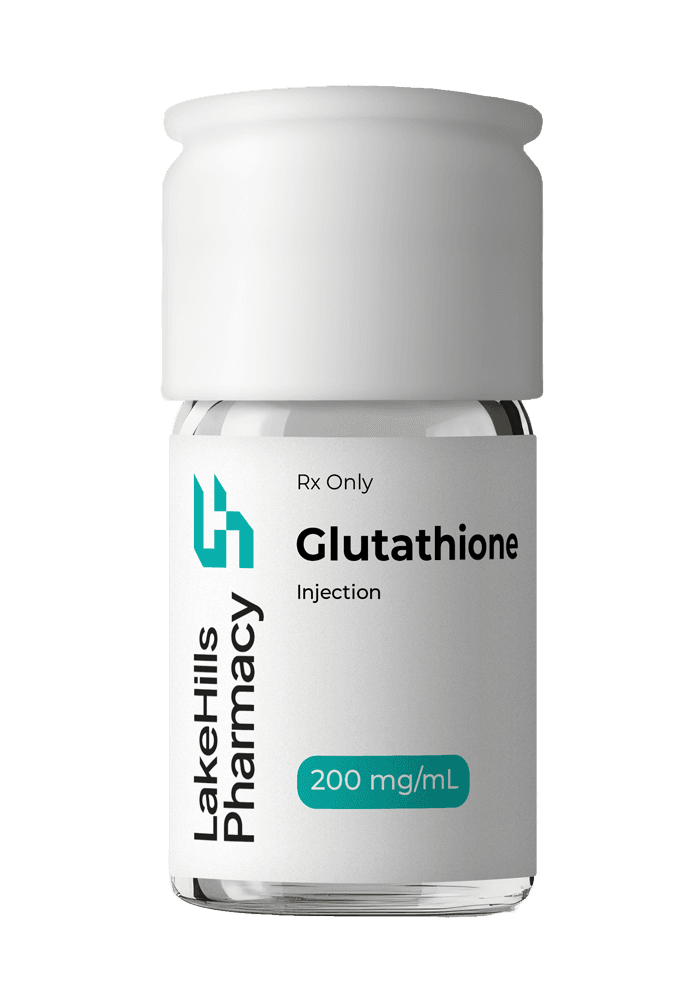
Glutathione Injection is a sterile injectable solution that Lake Hills Pharmacy compounds as a 503A pharmacy, pursuant to a patient-specific prescription. Glutathione (gamma-glutamyl-cysteinyl-glycine) is a tripeptide of glutamate, cysteine and glycine and the main intracellular thiol antioxidant. Glutathione is not the active ingredient of any FDA-approved drug product, and no FDA-labeled indication or dose exists. Prescribers use compounded glutathione injection at their discretion.
Active Ingredients & Strengths
- Active ingredient: glutathione (reduced).
- Available strength: 200 mg/mL, 5 mL vial.
- Routes: intramuscular and intravenous.
Dosing & Administration
No FDA-labeled dose exists for this route; dosing is individualized by the prescriber. Administer as prescribed by intramuscular or intravenous injection using aseptic technique. Intravenous administration should be performed by a healthcare professional.
Inspect the solution before use; do not use if it is cloudy, discolored or contains particles.
Key Safety Information
- Do not use with known hypersensitivity to glutathione or any ingredient of the preparation. Hypersensitivity reactions, including rash and, rarely, anaphylaxis, have been reported.
- Inhaled glutathione has caused bronchospasm in people with asthma; use caution in patients with reactive airway disease.
- Injectable glutathione is not FDA-approved for skin lightening and should not be used for that purpose.
- Interactions are not well characterized. Because glutathione is an antioxidant, prescribers should coordinate with the oncology team for patients receiving chemotherapy or radiation.
- Other reported effects include injection-site pain, redness and swelling, flushing, nausea and abdominal discomfort. Safety in pregnancy and breastfeeding has not been established.
Storage, Stability & BUD
- Storage: refrigerated, 2 °C to 8 °C, protected from light; do not freeze.
- Beyond-use date: per the prescription label.
- USP default BUD (USP <797>, Category 2, no sterility testing): 1 day at room temperature, 4 days refrigerated or 45 days frozen when prepared from one or more nonsterile starting components; 4, 10 or 45 days when prepared only from sterile starting components. Longer USP dating applies after terminal sterilization or a passing sterility test.
- Lake Hills may assign extended dating based on its own stability data.
- If supplied as a preserved multiple-dose vial, follow the prescription label for in-use dating after first puncture.
Patient Counseling
- Use this medication exactly as your prescriber directs. Do not change the amount or how often you use it without talking to your prescriber.
- Keep the vial in the refrigerator and out of light. Do not freeze it.
- If you inject at home, use a new sterile needle and syringe every time, clean the vial stopper with alcohol, and dispose of needles in a sharps container.
- Get emergency care for trouble breathing, wheezing, swelling of the face or throat, or a widespread rash.
- Tell your prescriber if you are pregnant or breastfeeding, have asthma, or are receiving cancer treatment.
References
- Natural Medicines Comprehensive Database: Glutathione.
- USP General Chapter <797> Pharmaceutical Compounding, Sterile Preparations.
Active ingredients
Glutathione
Antioxidant
Overview
Glutathione (gamma-L-glutamyl-L-cysteinyl-glycine) is a tripeptide of glutamate, cysteine and glycine and the main intracellular thiol antioxidant. It is a bulk substance with no FDA-approved drug product in the United States, and no FDA-labeled indication or dose exists. Oral glutathione is sold as a dietary supplement. Compounded preparations include injectable solutions for intramuscular or intravenous use and rectal or vaginal suppositories.
Indications & Uses
- No FDA-labeled indication exists. Prescribers use compounded glutathione at their discretion. Injectable glutathione is not FDA-approved for skin lightening and should not be used for that purpose.
Mechanism of Action
Reduced glutathione (GSH) donates electrons through its cysteine thiol to neutralize reactive oxygen species and is oxidized to glutathione disulfide (GSSG), which glutathione reductase recycles using NADPH. GSH is a cofactor for glutathione peroxidases, conjugates electrophiles and drug metabolites through glutathione S-transferases, helps regenerate vitamins C and E, and maintains protein thiol status.
Pharmacokinetics
Exogenous glutathione is cleared rapidly. After intravenous administration, plasma glutathione falls within minutes, with a reported half-life of roughly 10 minutes, as it is hydrolyzed by gamma-glutamyl transpeptidase, mainly in the kidney, into its amino acids, which cells take up to resynthesize glutathione.
Oral bioavailability is low and variable because of intestinal and hepatic breakdown. Absorption after intramuscular, rectal or vaginal administration has not been well characterized; the rectal route only partly avoids first-pass metabolism.
Contraindications
- Known hypersensitivity to glutathione or any ingredient of the preparation.
Warnings & Precautions
- Hypersensitivity reactions, including rash, urticaria and, rarely, anaphylaxis. Injectable use should be supervised by a healthcare professional able to manage allergic reactions.
- Nebulized glutathione has caused bronchoconstriction in people with asthma; use caution in patients with reactive airway disease.
- Compounded injectables carry risks of contamination and endotoxin; preparations must meet USP <797> standards. Safety of long-term or high-dose use has not been established, and data in hepatic or renal impairment are limited.
Drug Interactions
- No clinically significant drug interactions have been well established. Because glutathione is an antioxidant, there is a theoretical concern that it could interfere with chemotherapy or radiation that relies on oxidative mechanisms; coordinate with the oncology team. Acetaminophen overdose depletes hepatic glutathione; the standard antidote is acetylcysteine, not glutathione.
Adverse Effects
Reported effects include injection-site pain, redness and swelling, flushing, nausea, abdominal cramping, bloating and loose stools, rash and, rarely, anaphylaxis. Rectal or vaginal use can cause local irritation, itching or burning. Isolated reports of liver test abnormalities after intravenous use have been described.
Pregnancy & Lactation
Glutathione is an endogenous compound, but the safety of supplemental glutathione in pregnancy and lactation has not been established. Use is not recommended during pregnancy or breastfeeding unless the prescriber judges the benefit to outweigh unknown risks.
Monitoring
Monitor for hypersensitivity reactions during and after injection, injection-site reactions, respiratory symptoms in patients with asthma, and local tolerance with suppositories. Consider periodic liver function testing with repeated intravenous use.
References
- Natural Medicines Comprehensive Database: Glutathione.
- USP General Chapter <797> Pharmaceutical Compounding, Sterile Preparations.
- USP General Chapter <795> Pharmaceutical Compounding, Nonsterile Preparations.
Ask a pharmacist
Are compounded medications FDA approved?
All formulations are patient-specific prescriptions compounded by Lake Hills Pharmacy under FDA section 503A. Individual ingredients are FDA-approved; compounded products are not reviewed by the FDA for safety, effectiveness, or quality. For licensed healthcare providers only.
How do I get a prescription filled here?
You can have your doctor send prescriptions to us any time. We also transfer your medications from another pharmacy. Our pharmacy accepts all major insurance plans.
Can you ship this medication to my state?
It depends on the medication and on your state. Whether we can dispense or ship a medication to you depends on the laws and board of pharmacy rules of your state and on our licensure there. We confirm availability when we receive a prescription.
These answers cover the basics. For anything about a formula, a strength or a prescription, contact our pharmacists.
Mon - Fri: 8:30am - 6:30pm CTSaturday: 9:00am - 2:00pm CTSunday: Closed
12005 Bee Cave Rd, Suite 1-A, Austin, TX 78738