
- Active ingredients
- Dosage form
- Suspension
- Route
- Oral
- Care area
- Drug class
- Other
- DEA schedule
- Non-controlled
- Storage
- Refrigerated


Compounded and dispensed by an NABP-accredited, LegitScript-certified pharmacy. Verify accreditation (opens in a new tab)
About compounded medications
All formulations are patient-specific prescriptions compounded by Lake Hills Pharmacy under FDA section 503A. Individual ingredients are FDA-approved; compounded products are not reviewed by the FDA for safety, effectiveness, or quality. For licensed healthcare providers only.
Available Dosage Strengths
Strengths are compounded to the prescriber's order.
Clinical information
Product Overview
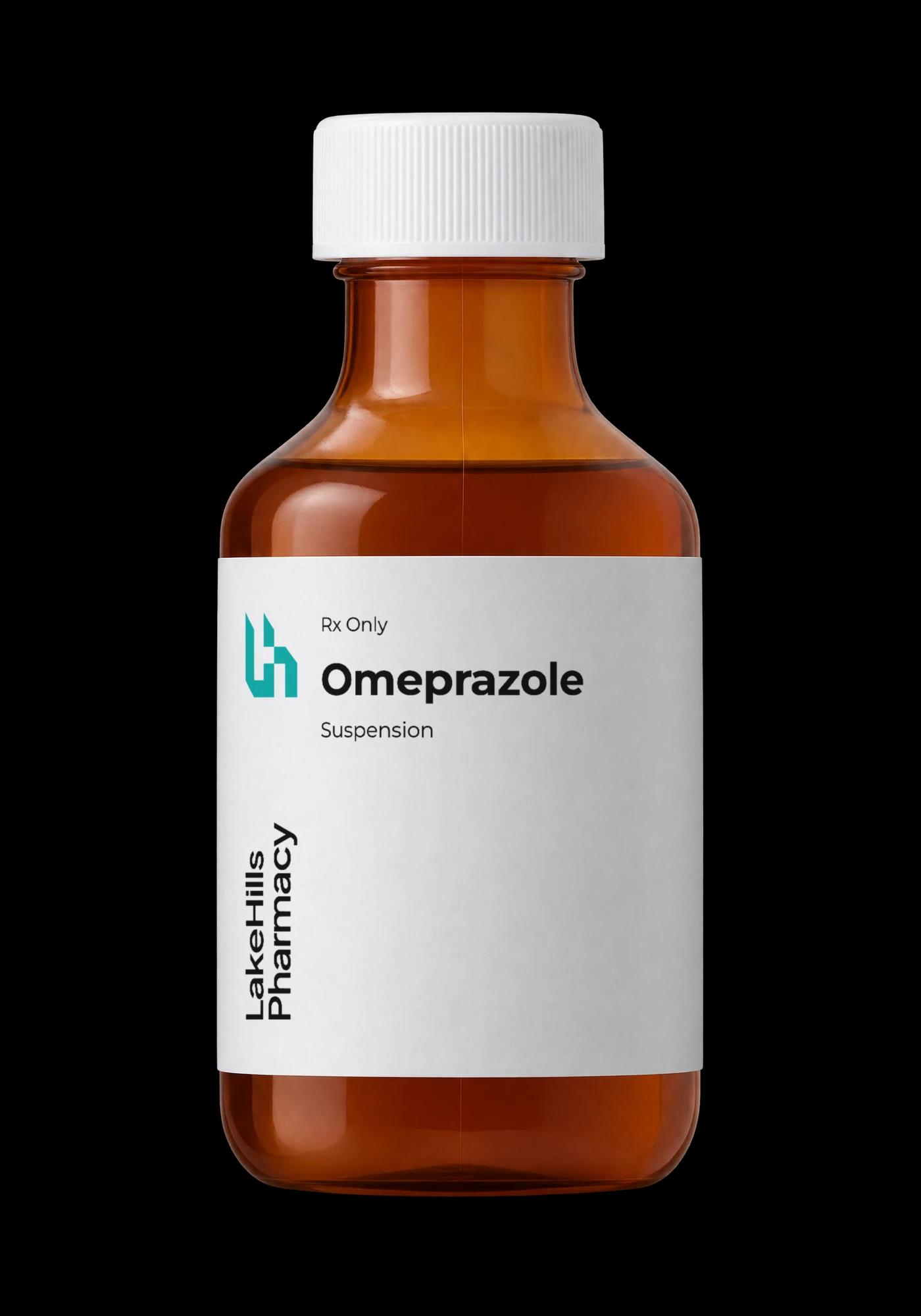
Omeprazole Oral Suspension is a nonsterile oral liquid suspension of omeprazole, a proton pump inhibitor, in a sodium bicarbonate vehicle. Lake Hills Pharmacy compounds it as a 503A pharmacy, pursuant to a patient-specific prescription, for patients who need a liquid dosage form, including those with a feeding tube.
Omeprazole (reference product Prilosec delayed-release capsules and delayed-release oral suspension) is FDA labeled for duodenal and gastric ulcer, H. pylori eradication as part of combination therapy, symptomatic GERD, erosive esophagitis and its maintenance, and pathological hypersecretory conditions.
Active Ingredients & Strengths
Strength is set on each prescription; contact Lake Hills Pharmacy for available strengths.
Dosing & Administration
Give by mouth or through a feeding tube as prescribed. For reference, Prilosec labeling uses 20 mg once daily in adults for most indications (40 mg for gastric ulcer and higher doses for hypersecretory conditions), and weight-based pediatric doses of 5 mg, 10 mg or 20 mg once daily depending on body weight. The milligram dose in each milliliter depends on the strength dispensed.
Shake well before each dose, and give before a meal as prescribed.
Key Safety Information
- Contraindicated with hypersensitivity to any PPI and with rilpivirine-containing products.
- Symptom response does not exclude gastric malignancy. Long-term PPI use is associated with C. difficile-associated diarrhea, bone fracture, hypomagnesemia, vitamin B12 deficiency, fundic gland polyps, acute tubulointerstitial nephritis, cutaneous and systemic lupus erythematosus, and severe cutaneous adverse reactions.
- Interactions: avoid with clopidogrel (reduced activation through CYP2C19), atazanavir and nelfinavir; omeprazole can raise levels of methotrexate (high dose), tacrolimus, citalopram, cilostazol, phenytoin, diazepam and digoxin, may affect warfarin, reduces exposure to mycophenolate mofetil, and reduces absorption of pH-dependent drugs such as ketoconazole, iron salts and erlotinib. St. John's wort and rifampin lower omeprazole levels.
- The sodium bicarbonate vehicle adds sodium; consider the sodium content in patients on sodium restriction.
Storage, Stability & BUD
- Storage: refrigerated, 2°C to 8°C (36°F to 46°F), tightly closed and protected from light.
- Beyond-use date: per the prescription label.
- USP default BUD (USP <795>): 35 days at controlled room temperature or refrigerated for a preserved aqueous preparation, 14 days refrigerated for a nonpreserved aqueous preparation, or 90 days for a nonaqueous preparation; the category follows the Lake Hills base and vehicle.
- Lake Hills may assign extended dating based on its own stability data.
Patient Counseling
Use this medication exactly as your prescriber directs. Do not change the amount or how often you use it without talking to your prescriber.
- Keep the bottle in the refrigerator and measure each dose with an oral syringe or dosing device, not a kitchen spoon.
- Call your prescriber for watery diarrhea that does not go away, muscle cramps or a racing heartbeat, joint pain with a rash on the cheeks or arms, or trouble swallowing, vomiting blood or black stools.
References
- Prilosec (omeprazole) delayed-release capsules and delayed-release oral suspension Prescribing Information.
- USP General Chapter <795> Pharmaceutical Compounding: Nonsterile Preparations.
Active ingredients
Omeprazole
Overview
Omeprazole is a substituted benzimidazole proton pump inhibitor (PPI). FDA-approved products include Prilosec delayed-release capsules and delayed-release oral suspension packets, generic delayed-release capsules, over-the-counter delayed-release tablets, and an immediate-release combination with sodium bicarbonate (Zegerid). Omeprazole is compounded into oral liquids pursuant to patient-specific prescriptions.
Indications & Uses
- Treatment of active duodenal ulcer and active benign gastric ulcer.
- Helicobacter pylori eradication to reduce duodenal ulcer recurrence, in combination with antibiotics.
- Treatment of symptomatic gastroesophageal reflux disease (GERD) and erosive esophagitis, and maintenance of healing of erosive esophagitis.
- Pathological hypersecretory conditions such as Zollinger-Ellison syndrome.
- Pediatric GERD and erosive esophagitis from 1 month (erosive esophagitis due to acid-mediated GERD) or 1 year of age, depending on indication.
Mechanism of Action
Omeprazole is a prodrug that accumulates in the acidic canaliculi of gastric parietal cells, where it converts to a sulfenamide that covalently and irreversibly inhibits H+/K+-ATPase, the final step of acid secretion. It suppresses basal and stimulated acid secretion; acid secretion recovers as new pumps are synthesized.
Pharmacokinetics
Omeprazole is acid labile, so it is given in delayed-release forms or with sodium bicarbonate. Bioavailability is about 30 to 40% and rises with repeated dosing. It is about 95% protein bound and is metabolized by CYP2C19 and, to a lesser extent, CYP3A4; CYP2C19 poor metabolizers and Asian populations have higher exposure. Plasma half-life is 0.5 to 1 hour, but acid suppression lasts up to 72 hours. Metabolites are excreted mainly in urine.
Contraindications
- Hypersensitivity to omeprazole or other substituted benzimidazoles; reactions have included anaphylaxis, angioedema, bronchospasm, acute tubulointerstitial nephritis and urticaria.
- Coadministration with rilpivirine-containing products.
Warnings & Precautions
- Symptomatic response does not exclude gastric malignancy; consider additional evaluation in adults with suboptimal response or early relapse.
- Acute tubulointerstitial nephritis can occur at any time; stop omeprazole if it develops.
- Clostridioides difficile-associated diarrhea, bone fracture with high-dose or long-term use, hypomagnesemia (and associated hypocalcemia and hypokalemia), and vitamin B12 deficiency with long-term use.
- Cutaneous and systemic lupus erythematosus; severe cutaneous adverse reactions including Stevens-Johnson syndrome and DRESS.
- Fundic gland polyps with long-term use. Elevated chromogranin A can interfere with neuroendocrine tumor testing; stop the PPI at least 14 days before testing.
Drug Interactions
Avoid with clopidogrel (reduced conversion to its active metabolite through CYP2C19 inhibition), atazanavir and nelfinavir; contraindicated with rilpivirine. Omeprazole can raise levels of saquinavir, tacrolimus, citalopram (QT risk), cilostazol, phenytoin, diazepam, digoxin and high-dose methotrexate, may alter warfarin effect, and reduces mycophenolate mofetil exposure. It reduces absorption of drugs that need gastric acid, such as ketoconazole, itraconazole, iron salts, erlotinib and dasatinib. St. John's wort and rifampin lower omeprazole levels; voriconazole raises them.
Adverse Effects
Headache, abdominal pain, nausea, diarrhea, vomiting and flatulence are most common; respiratory infection, fever and rash occur in children. Long-term effects are listed under Warnings and Precautions.
Pregnancy & Lactation
Available data from observational studies have not shown an increased risk of major malformations or other adverse pregnancy outcomes with omeprazole. Omeprazole is present in human milk in small amounts; consider the benefits of breastfeeding with the mother's need for treatment.
Monitoring
Symptom response; magnesium at baseline and periodically with long-term use or with digoxin or diuretics; vitamin B12 with long-term use; renal function if nephritis is suspected; INR with warfarin; tacrolimus and methotrexate levels when coadministered.
References
- Prilosec (omeprazole) delayed-release capsules and delayed-release oral suspension Prescribing Information.
- Zegerid (omeprazole and sodium bicarbonate) Prescribing Information.
Ask a pharmacist
Are compounded medications FDA approved?
All formulations are patient-specific prescriptions compounded by Lake Hills Pharmacy under FDA section 503A. Individual ingredients are FDA-approved; compounded products are not reviewed by the FDA for safety, effectiveness, or quality. For licensed healthcare providers only.
How do I get a prescription filled here?
You can have your doctor send prescriptions to us any time. We also transfer your medications from another pharmacy. Our pharmacy accepts all major insurance plans.
Can you ship this medication to my state?
It depends on the medication and on your state. Whether we can dispense or ship a medication to you depends on the laws and board of pharmacy rules of your state and on our licensure there. We confirm availability when we receive a prescription.
These answers cover the basics. For anything about a formula, a strength or a prescription, contact our pharmacists.
Mon - Fri: 8:30am - 6:30pm CTSaturday: 9:00am - 2:00pm CTSunday: Closed
12005 Bee Cave Rd, Suite 1-A, Austin, TX 78738