
- Active ingredients
- Dosage form
- Cream
- Route
- Topical
- Care area
- Drug class
- Opioid antagonist
- DEA schedule
- Non-controlled
- Storage
- Room temperature

Compounded and dispensed by an NABP-accredited, LegitScript-certified pharmacy. Verify accreditation (opens in a new tab)
About compounded medications
All formulations are patient-specific prescriptions compounded by Lake Hills Pharmacy under FDA section 503A. Individual ingredients are FDA-approved; compounded products are not reviewed by the FDA for safety, effectiveness, or quality. For licensed healthcare providers only.
Available Dosage Strengths
Cream
4 mg/
mL Unit size: 30 g
32 mg/
mL Unit size: 30 g
Clinical information
Product Overview
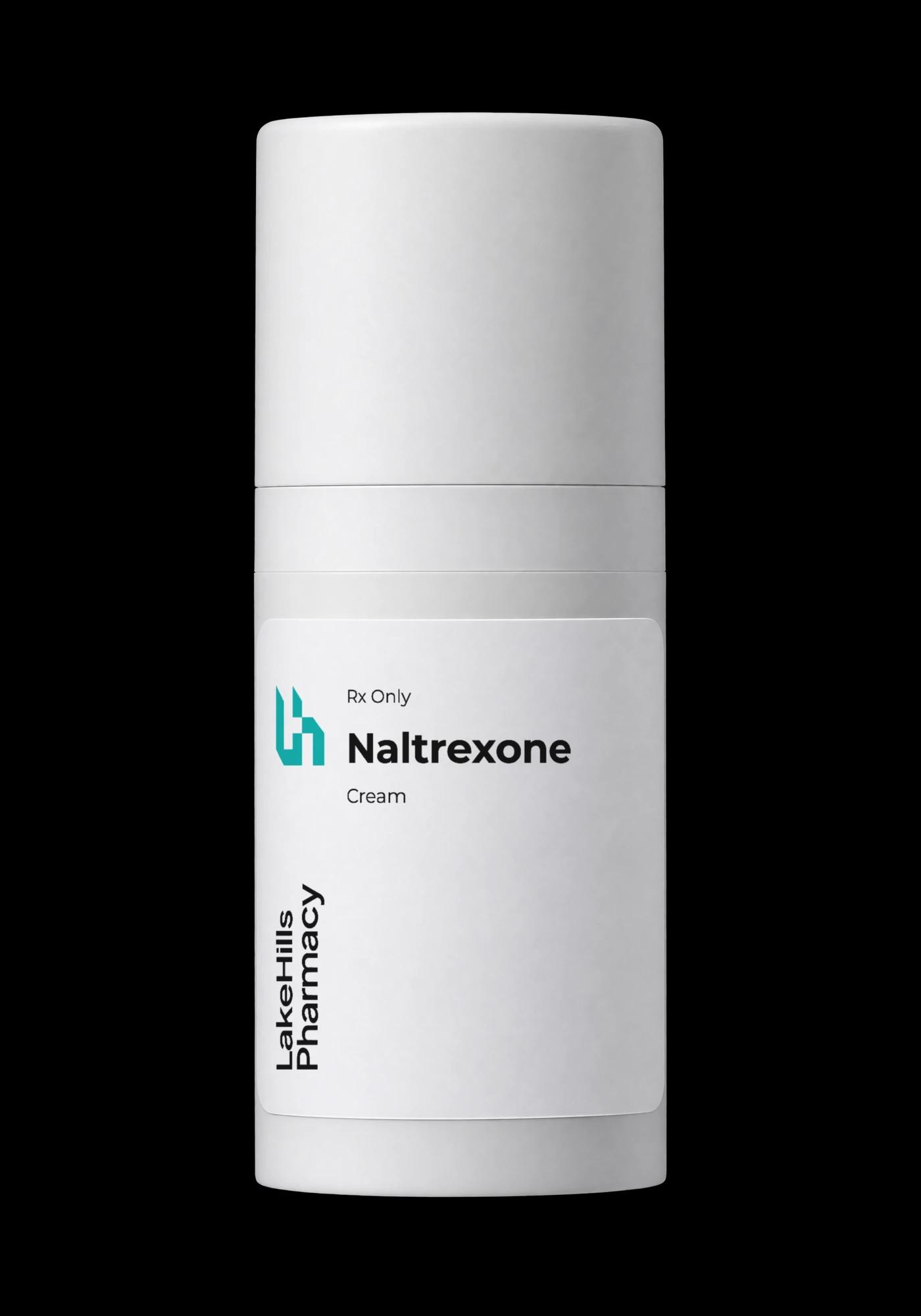
Naltrexone Cream is a nonsterile topical cream of naltrexone hydrochloride. Lake Hills Pharmacy compounds it as a 503A pharmacy, pursuant to a patient-specific prescription.
Naltrexone, an opioid receptor antagonist, is FDA labeled orally (50 mg tablets) and as an extended-release intramuscular injection (Vivitrol) for alcohol dependence and blockade of exogenously administered opioids. No topical naltrexone product is FDA approved. Prescribers use compounded topical naltrexone for dermatologic conditions such as pruritus; this use is not FDA labeled.
Active Ingredients & Strengths
- Naltrexone HCl 4 mg/mL cream, 30 g.
- Naltrexone HCl 32 mg/mL cream, 30 g.
Dosing & Administration
Apply to the affected skin as prescribed. No FDA-labeled dose exists for this route; dosing is individualized by the prescriber.
Key Safety Information
- Do not use in patients with hypersensitivity to naltrexone or any component of the cream base.
- Opioids: naltrexone blocks opioid effects and can precipitate withdrawal in opioid-dependent patients, including those on methadone or buprenorphine. Systemic absorption from topical use has not been well characterized, particularly at higher strengths or over large or broken skin; avoid in patients taking opioids or in acute opioid withdrawal unless the prescriber directs, and tell all clinicians before procedures that may need opioid analgesia.
- Local irritation, redness, itching or rash can occur. Avoid open wounds and actively infected skin unless the prescriber directs.
- Oral naltrexone labeling warns of hepatotoxicity at doses well above 50 mg daily and lists acute hepatitis and liver failure among contraindications; systemic exposure from topical use is expected to be much lower.
- Safety in pregnancy and breastfeeding has not been established; use only if the prescriber judges it necessary.
Storage, Stability & BUD
- Storage: room temperature, tightly closed and away from excessive heat.
- Beyond-use date: per the prescription label.
- USP default BUD (USP <795>): 35 days at controlled room temperature or refrigerated for a preserved aqueous preparation, 14 days refrigerated for a nonpreserved aqueous preparation, or 90 days for a nonaqueous preparation; the category follows the Lake Hills base and vehicle.
- Lake Hills may assign extended dating based on its own stability data.
Patient Counseling
Use this medication exactly as your prescriber directs. Do not change the amount or how often you use it without talking to your prescriber.
- Tell every prescriber, dentist and pharmacist that you use naltrexone, especially before surgery or if you may need opioid pain medicine.
- Wash your hands after applying unless your hands are the treated area.
- Stop and call your prescriber for a spreading rash, blistering, or signs of opioid withdrawal such as sweating, cramping or diarrhea.
References
- Naltrexone Hydrochloride Tablets USP Prescribing Information.
- Vivitrol (naltrexone for extended-release injectable suspension) Prescribing Information, Alkermes.
- USP General Chapter <795> Pharmaceutical Compounding: Nonsterile Preparations.
Active ingredients
Naltrexone Hydrochloride
Opioid antagonist
Overview
Naltrexone hydrochloride is a long-acting opioid receptor antagonist. FDA-approved products are naltrexone hydrochloride 50 mg oral tablets and naltrexone extended-release injectable suspension (Vivitrol, 380 mg IM monthly); naltrexone is also a component of an approved oral combination with bupropion. Lower oral strengths and topical forms are compounded pursuant to patient-specific prescriptions.
Indications & Uses
- Oral tablets: treatment of alcohol dependence, and blockade of the effects of exogenously administered opioids, as part of a comprehensive treatment program.
- Extended-release injection: alcohol dependence in patients able to abstain in an outpatient setting, and prevention of relapse to opioid dependence following opioid detoxification.
- Prescribers use compounded low-dose oral naltrexone (LDN, typically well under 50 mg) and topical naltrexone off-label; these uses are not FDA labeled.
Mechanism of Action
Naltrexone competitively antagonizes mu, and to a lesser extent kappa and delta, opioid receptors, blocking the effects of exogenous opioids. At low doses it is hypothesized to cause transient opioid-receptor blockade with a rebound in endogenous opioid signaling and to antagonize toll-like receptor 4 on microglia; these mechanisms are not established. Proposed local actions of topical naltrexone on cutaneous opioid receptors are route-specific and hypothesized.
Pharmacokinetics
Oral naltrexone is well absorbed but undergoes extensive first-pass metabolism, with bioavailability of about 5 to 40%. It is metabolized by dihydrodiol dehydrogenase to the active metabolite 6-beta-naltrexol, not by CYP450. Half-life is about 4 hours for naltrexone and about 13 hours for 6-beta-naltrexol; both are excreted mainly in urine. Systemic absorption after topical application has not been well characterized.
Contraindications
- Patients receiving opioid analgesics, or with current physiologic opioid dependence, including those on methadone or buprenorphine.
- Acute opioid withdrawal, a failed naloxone challenge test, or a positive urine screen for opioids.
- Hypersensitivity to naltrexone or any component.
- Topical use only: application to open wounds or actively infected skin, unless the prescriber directs.
Warnings & Precautions
- Opioid overdose: attempts to overcome blockade with high opioid doses can cause fatal overdose; after stopping naltrexone or missing doses, reduced opioid tolerance increases overdose risk.
- Precipitated opioid withdrawal can be severe in patients not fully opioid-free; an opioid-free interval of 7 to 10 days (longer for long-acting opioids) is recommended before starting.
- Hepatotoxicity has occurred at doses above those labeled; use caution in hepatic disease and check liver tests if symptoms occur.
- Depression and suicidal thoughts have been reported in naltrexone-treated patients; monitor mood.
- Patients needing opioid analgesia may require regional anesthesia, non-opioid analgesics or monitored high-dose opioids in a setting equipped for resuscitation.
- Extended-release injection: injection-site reactions, eosinophilic pneumonia and hypersensitivity.
Drug Interactions
Opioid-containing medicines, including analgesics, cough products with codeine, and antidiarrheals such as diphenoxylate, lose their effect. Lethargy and somnolence were reported with thioridazine. Disulfiram and other hepatotoxic drugs add to liver risk.
Adverse Effects
Oral: nausea, headache, dizziness, fatigue, insomnia or vivid dreams, anxiety, abdominal pain, vomiting and decreased appetite. Low-dose use: sleep disturbance and vivid dreams are commonly reported. Injection: injection-site pain, induration and nodules. Topical: local irritation, redness or itching.
Pregnancy & Lactation
Human data on naltrexone in pregnancy are limited and do not establish a drug-associated risk; use if the prescriber judges benefit outweighs risk. Naltrexone and 6-beta-naltrexol pass into breast milk in small amounts; consider the benefits of breastfeeding with the mother's need for treatment.
Monitoring
Confirm opioid-free status before starting; liver tests at baseline and as clinically indicated; mood and suicidality; adherence and overdose-risk counseling in patients with opioid use disorder; local skin tolerance with topical use.
References
- Naltrexone Hydrochloride Tablets USP Prescribing Information.
- Revia (naltrexone hydrochloride tablets) Prescribing Information.
- Vivitrol (naltrexone for extended-release injectable suspension) Prescribing Information, Alkermes.
Ask a pharmacist
Are compounded medications FDA approved?
All formulations are patient-specific prescriptions compounded by Lake Hills Pharmacy under FDA section 503A. Individual ingredients are FDA-approved; compounded products are not reviewed by the FDA for safety, effectiveness, or quality. For licensed healthcare providers only.
How do I get a prescription filled here?
You can have your doctor send prescriptions to us any time. We also transfer your medications from another pharmacy. Our pharmacy accepts all major insurance plans.
Can you ship this medication to my state?
It depends on the medication and on your state. Whether we can dispense or ship a medication to you depends on the laws and board of pharmacy rules of your state and on our licensure there. We confirm availability when we receive a prescription.
These answers cover the basics. For anything about a formula, a strength or a prescription, contact our pharmacists.
Mon - Fri: 8:30am - 6:30pm CTSaturday: 9:00am - 2:00pm CTSunday: Closed
12005 Bee Cave Rd, Suite 1-A, Austin, TX 78738