
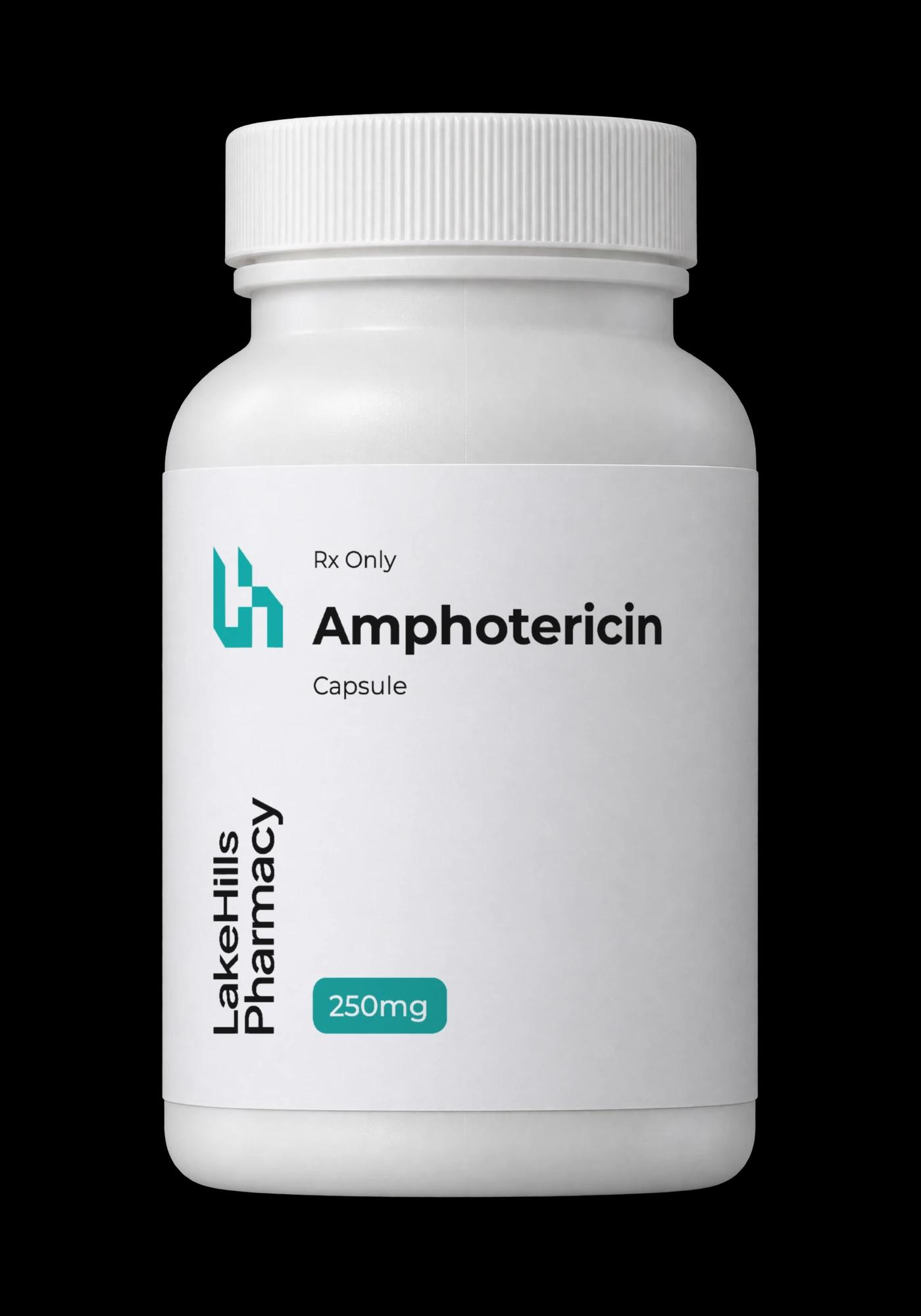
- Active ingredients
- Dosage form
- Capsule
- Route
- Oral
- Care area
- Drug class
- Other
- DEA schedule
- Non-controlled
- Storage
- Refrigerated


Compounded and dispensed by an NABP-accredited, LegitScript-certified pharmacy. Verify accreditation (opens in a new tab)
About compounded medications
All formulations are patient-specific prescriptions compounded by Lake Hills Pharmacy under FDA section 503A. Individual ingredients are FDA-approved; compounded products are not reviewed by the FDA for safety, effectiveness, or quality. For licensed healthcare providers only.
Available Dosage Strengths
Capsule
250 mg
Clinical information
Boxed Warning
Conventional amphotericin B for injection: it should be used primarily for patients with progressive, potentially life-threatening fungal infections, and not for noninvasive fungal infections such as oral thrush, vaginal candidiasis or esophageal candidiasis in patients with normal neutrophil counts. Take care to prevent inadvertent overdose, which can cause cardiopulmonary arrest; verify the product name and dose if a dose exceeds 1.5 mg/kg. AmBisome and Abelcet do not carry a boxed warning.
Product Overview
Amphotericin B Capsules are a nonsterile oral capsule of amphotericin B, a polyene antifungal, that Lake Hills Pharmacy compounds as a 503A pharmacy, pursuant to a patient-specific prescription. Amphotericin B is negligibly absorbed from the gastrointestinal tract, so an oral dose acts locally in the gut lumen and does not produce therapeutic blood levels.
Oral capsules cannot treat invasive or systemic fungal infections (for example invasive candidiasis, aspergillosis, cryptococcosis or mucormycosis) or visceral leishmaniasis; those require parenteral therapy. FDA-labeled US amphotericin B products are intravenous (amphotericin B for injection, AmBisome and Abelcet) for serious systemic fungal infections and, for AmBisome, visceral leishmaniasis. Prescribers use compounded oral amphotericin B for local antifungal effect in the gastrointestinal tract, such as intestinal yeast overgrowth or selective gut decontamination.
Active Ingredients & Strengths
- Amphotericin B 250 mg capsule (listed unit: 1 each).
Dosing & Administration
Oral, as prescribed. No FDA-labeled dose exists for this route; dosing is individualized by the prescriber. Intravenous doses do not apply to oral capsules, and oral milligram amounts are not interchangeable with intravenous doses.
Key Safety Information
- The boxed warning on conventional amphotericin B for injection concerns intravenous use: it is for progressive, potentially life-threatening fungal infections, not for noninvasive infections such as oral thrush or vaginal or esophageal candidiasis in patients with normal neutrophil counts, and overdose can cause cardiopulmonary arrest.
- Contraindicated with hypersensitivity to amphotericin B or any capsule ingredient.
- Oral use most often causes nausea, vomiting, abdominal cramping and diarrhea; rash and allergic reactions are uncommon. Renal toxicity, electrolyte loss and infusion reactions seen with intravenous therapy are not expected at the low levels absorbed orally.
- Interactions: none clinically significant are expected with oral use. The interaction profile of intravenous amphotericin B (other nephrotoxic drugs, corticosteroids, digoxin, flucytosine) applies to systemic exposure.
- Pregnancy and lactation: data for oral use are limited; the prescriber weighs benefit and risk.
Storage, Stability & BUD
Storage: refrigerated, 2–8 °C (36–46 °F), in the dispensed container, protected from light and moisture.
Beyond-use date: per the prescription label.
USP default BUD for this dosage form: 180 days, stored refrigerated (nonsterile solid dosage form, USP <795>).
Lake Hills may assign extended dating based on its own stability data.
Patient Counseling
Take the capsules exactly as the prescriber directs and for as long as directed. Do not change the dose or stop early without talking to the prescriber.
This medicine acts only inside the digestive tract. Report fever, worsening symptoms, rash, swelling or severe or persistent stomach upset.
Keep the capsules in the refrigerator in the container provided. Pregnant or breastfeeding patients should discuss use with the prescriber.
References
- Amphotericin B for Injection, USP, Prescribing Information, X-Gen Pharmaceuticals.
- AmBisome (amphotericin B) liposome for injection Prescribing Information, Astellas Pharma US.
- Abelcet (amphotericin B lipid complex) Prescribing Information, Leadiant Biosciences.
- Clinical Practice Guideline for the Management of Candidiasis: 2016 Update, Infectious Diseases Society of America.
- USP General Chapter <795> Pharmaceutical Compounding — Nonsterile Preparations.
Active ingredients
Amphotericin B
Overview
Amphotericin B is a polyene macrolide antifungal produced by Streptomyces nodosus. Current US products are intravenous: conventional amphotericin B deoxycholate for injection, liposomal amphotericin B (AmBisome) and amphotericin B lipid complex (Abelcet). No oral amphotericin B product is currently marketed in the US. Lake Hills Pharmacy uses amphotericin B bulk drug substance in compounded oral capsules.
Indications & Uses
- Conventional amphotericin B for injection: progressive, potentially life-threatening fungal infections, including aspergillosis, cryptococcosis, blastomycosis, systemic candidiasis, coccidioidomycosis, histoplasmosis, zygomycosis including mucormycosis, and sporotrichosis; also American mucocutaneous leishmaniasis.
- AmBisome: empirical therapy for presumed fungal infection in febrile neutropenic patients; cryptococcal meningitis in HIV infection; Aspergillus, Candida or Cryptococcus infections refractory to or intolerant of conventional amphotericin B; and visceral leishmaniasis.
- Abelcet: invasive fungal infections in patients refractory to or intolerant of conventional amphotericin B.
- Oral use: prescribers use compounded oral amphotericin B for local antifungal action within the gastrointestinal tract. Because it is not absorbed, oral amphotericin B does not treat systemic or invasive infections.
Mechanism of Action
Amphotericin B binds ergosterol in the fungal cell membrane and forms transmembrane pores, causing leakage of potassium and other intracellular contents and cell death. It is fungicidal or fungistatic depending on concentration and organism. Its lower but real affinity for cholesterol in human cell membranes underlies its toxicity, especially in the kidney. Its spectrum includes Candida, Aspergillus, Cryptococcus, the Mucorales and the endemic dimorphic fungi, and it is active against Leishmania.
Pharmacokinetics
Oral amphotericin B is negligibly absorbed and is eliminated largely unchanged in the feces, so oral doses act only within the gut lumen. After intravenous dosing, conventional amphotericin B is more than 90% protein bound and distributes extensively into tissues; it is eliminated slowly, with a terminal half-life of about 15 days. It is not removed by hemodialysis. Lipid formulations differ in distribution and dosing and are not interchangeable with the conventional product.
Contraindications
- Hypersensitivity to amphotericin B or any component, unless the condition is life-threatening and treatable only with amphotericin B.
Warnings & Precautions
- Intravenous use: infusion reactions (fever, chills, rigors, nausea, hypotension), anaphylaxis, nephrotoxicity, hypokalemia, hypomagnesemia, renal tubular acidosis and anemia.
- Rapid intravenous infusion can cause hyperkalemia and arrhythmia; acute pulmonary reactions have occurred with concurrent leukocyte transfusions.
- Conventional and lipid formulation doses differ substantially; confusion between them has caused fatal overdose.
- Oral use: gastrointestinal intolerance is the main concern; systemic toxicities are not expected at the low levels absorbed.
Drug Interactions
- Systemic exposure only: other nephrotoxic drugs (aminoglycosides, cyclosporine, tacrolimus, pentamidine, foscarnet) increase renal toxicity.
- Corticosteroids and corticotropin worsen hypokalemia; hypokalemia increases digoxin toxicity and enhances skeletal muscle relaxants.
- Flucytosine toxicity may increase through reduced renal excretion.
- No clinically significant interactions are expected with oral use because of minimal absorption.
Adverse Effects
Intravenous: fever, chills, rigors, headache, nausea, vomiting, hypotension, thrombophlebitis, renal impairment, hypokalemia, hypomagnesemia, anemia and, rarely, arrhythmia or anaphylaxis. Oral: nausea, vomiting, abdominal cramping and diarrhea, with rash and hypersensitivity reactions uncommon.
Pregnancy & Lactation
Amphotericin B crosses the placenta. Intravenous amphotericin B has long been used in pregnancy for serious fungal infections without evident teratogenicity, but controlled data are limited. Whether it is excreted in human milk is unknown. Systemic exposure from oral use is minimal; the prescriber weighs benefit and risk.
Monitoring
Intravenous: serum creatinine, BUN, potassium and magnesium (frequently during therapy), complete blood count, liver tests and infusion reactions. Oral: gastrointestinal tolerance and clinical response; systemic laboratory monitoring is needed only if systemic absorption is suspected.
References
- Amphotericin B for Injection, USP, Prescribing Information, X-Gen Pharmaceuticals.
- AmBisome (amphotericin B) liposome for injection Prescribing Information, Astellas Pharma US.
- Abelcet (amphotericin B lipid complex) Prescribing Information, Leadiant Biosciences.
- Clinical Practice Guideline for the Management of Candidiasis: 2016 Update, Infectious Diseases Society of America.
Ask a pharmacist
Are compounded medications FDA approved?
All formulations are patient-specific prescriptions compounded by Lake Hills Pharmacy under FDA section 503A. Individual ingredients are FDA-approved; compounded products are not reviewed by the FDA for safety, effectiveness, or quality. For licensed healthcare providers only.
How do I get a prescription filled here?
You can have your doctor send prescriptions to us any time. We also transfer your medications from another pharmacy. Our pharmacy accepts all major insurance plans.
Can you ship this medication to my state?
It depends on the medication and on your state. Whether we can dispense or ship a medication to you depends on the laws and board of pharmacy rules of your state and on our licensure there. We confirm availability when we receive a prescription.
These answers cover the basics. For anything about a formula, a strength or a prescription, contact our pharmacists.
Mon - Fri: 8:30am - 6:30pm CTSaturday: 9:00am - 2:00pm CTSunday: Closed
12005 Bee Cave Rd, Suite 1-A, Austin, TX 78738