
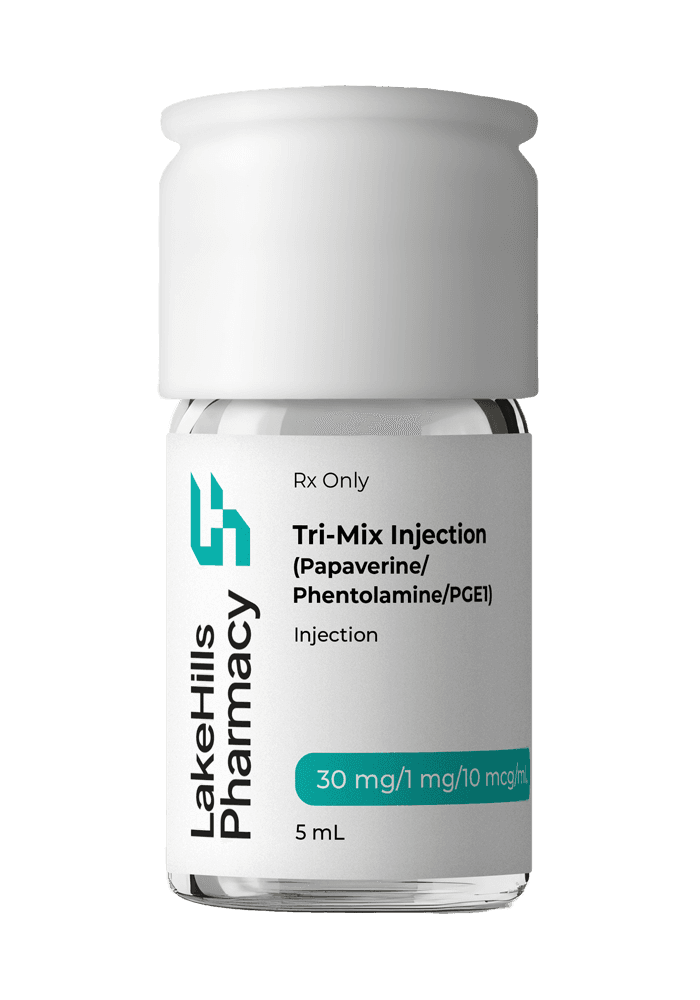
- Active ingredients
- Dosage form
- Injection
- Route
- Intracavernosal injection
- Care area
- Drug class
- Vasodilator / PDE5 inhibitor, Alpha blocker, Prostaglandin
- DEA schedule
- Non-controlled
- Sterile preparation
- Yes


Compounded and dispensed by an NABP-accredited, LegitScript-certified pharmacy. Verify accreditation (opens in a new tab)
About compounded medications
All formulations are patient-specific prescriptions compounded by Lake Hills Pharmacy under FDA section 503A. Individual ingredients are FDA-approved; compounded products are not reviewed by the FDA for safety, effectiveness, or quality. For licensed healthcare providers only.
Available Dosage Strengths
Injection
30 mg/
1 mg/ 10 mcg per mL Unit size: 5 mL vial
Clinical information
Boxed Warning · Alprostadil
Prostin VR Pediatric (intravenous use in neonates): apnea occurs in about 10 to 12% of neonates with congenital heart defects treated with alprostadil, most often in those under 2 kg and usually during the first hour of infusion. It should be used only where ventilatory assistance is immediately available, with respiratory status monitored throughout. The intracavernosal and urethral products do not carry a boxed warning.
Product Overview
Tri-Mix Injection is a sterile solution of papaverine hydrochloride, phentolamine mesylate and alprostadil (prostaglandin E1) for intracavernosal injection. Lake Hills Pharmacy compounds it as a 503A pharmacy, pursuant to a patient-specific prescription, in two variants listed as Tri-Mix and Super Tri-Mix. Prescribers use compounded intracavernosal combinations of these agents for erectile dysfunction.
Only alprostadil has an FDA-labeled intracavernosal indication: Caverject and Edex are labeled for erectile dysfunction due to neurogenic, vasculogenic, psychogenic or mixed etiology. Papaverine and phentolamine relax cavernosal smooth muscle and arterial walls, and alprostadil raises cAMP in the same tissue, increasing arterial inflow and limiting venous outflow.
Active Ingredients & Strengths
- Papaverine hydrochloride: vasodilator, non-selective phosphodiesterase inhibitor.
- Phentolamine mesylate: non-selective alpha-1 and alpha-2 adrenergic antagonist.
- Alprostadil (prostaglandin E1): prostaglandin vasodilator.
- Available: papaverine 30 mg / phentolamine 1 mg / alprostadil 10 mcg per mL, 5 mL vial.
Dosing & Administration
For intracavernosal injection only, as prescribed. No FDA-labeled dose exists for this combination, or for papaverine or phentolamine, by the intracavernosal route; dosing is individualized by the prescriber. Because the concentration of each active differs between variants, the prescription should state the dose as a volume of a named variant and concentration.
For reference, intracavernosal alprostadil labeling (Caverject, Edex) calls for the first injections and any dose adjustment to be done in the prescriber's office, with training in aseptic self-injection, and limits use to no more than three times per week with at least 24 hours between doses.
Key Safety Information
- Priapism: an erection lasting more than 4 hours needs prompt medical treatment to prevent permanent damage. Papaverine-containing mixtures carry a higher priapism risk than alprostadil alone.
- Contraindications: hypersensitivity to any component; conditions predisposing to priapism (sickle cell anemia or trait, multiple myeloma, leukemia); anatomic deformation of the penis (angulation, cavernosal fibrosis, Peyronie's disease); penile implants; men for whom sexual activity is inadvisable. Phentolamine labeling also contraindicates use with myocardial infarction or a history of myocardial infarction, coronary insufficiency, angina or other evidence of coronary artery disease.
- Penile fibrosis, nodules and curvature can develop with repeated injection; periodic penile examination is advised, and treatment stops if fibrosis or angulation appears.
- Bleeding and hematoma at the injection site are more likely with anticoagulants or bleeding disorders.
- Papaverine has been associated with hepatic hypersensitivity (eosinophilia, abnormal liver tests, jaundice); stop and evaluate if liver abnormalities appear.
- Phentolamine can cause hypotension, tachycardia and arrhythmia; myocardial infarction and cerebrovascular spasm or occlusion have been reported after parenteral use, usually with marked hypotension.
- Interactions: additive hypotension with PDE5 inhibitors, nitrates, alpha-blockers and other antihypertensives; combining with other erectile dysfunction treatments raises priapism risk; papaverine may reduce the effect of levodopa.
Storage, Stability & BUD
Storage: refrigerated or frozen, as stated on the prescription label; alprostadil in solution is heat-labile.
Beyond-use date: per the prescription label.
USP default BUD (USP <797>, Category 2, no sterility testing): 1 day at room temperature, 4 days refrigerated or 45 days frozen when prepared from one or more nonsterile starting components; 4, 10 or 45 days when prepared only from sterile starting components. Longer USP dating applies after terminal sterilization or a passing sterility test.
Lake Hills may assign extended dating based on its own stability data.
If supplied as a preserved multiple-dose vial, follow the prescription label for in-use dating after first puncture.
Patient Counseling
Use the medication exactly as the prescriber directs, including the dose volume, injection technique and how often to inject. Do not change the dose on your own.
Seek emergency care for an erection lasting more than 4 hours. Report penile pain, lumps, curvature, bruising that does not clear, dizziness or fainting.
Store the vial as stated on the prescription label and do not use it if the solution is cloudy, discolored or contains particles. Use each needle and syringe once and discard it in a sharps container.
Tell the prescriber about all other medicines, especially other erectile dysfunction treatments, blood thinners, nitrates and blood-pressure medicines.
References
- Caverject and Caverject Impulse (alprostadil) Prescribing Information, Pfizer.
- Edex (alprostadil) Prescribing Information.
- Papaverine Hydrochloride Injection, USP, manufacturer prescribing information.
- Phentolamine Mesylate for Injection, USP, manufacturer prescribing information.
- Erectile Dysfunction: AUA Guideline (2018), American Urological Association.
- USP General Chapter <797> Pharmaceutical Compounding — Sterile Preparations.
Active ingredients
Papaverine Hydrochloride
Vasodilator / PDE5 inhibitor
Overview
Papaverine hydrochloride is a benzylisoquinoline alkaloid originally isolated from opium. It has no narcotic or analgesic activity and is not a controlled substance. Drug class: vasodilator (non-selective phosphodiesterase inhibitor). In the US it is available as papaverine hydrochloride injection 30 mg/mL for intramuscular or slow intravenous use. Lake Hills Pharmacy uses it as a component of compounded intracavernosal preparations.
Indications & Uses
Papaverine injection labeling lists relief of conditions accompanied by smooth-muscle spasm: vascular spasm associated with acute myocardial infarction, angina, peripheral and pulmonary embolism, peripheral vascular disease with a vasospastic element and certain cerebral angiospastic states, and visceral spasm such as ureteral, biliary or gastrointestinal colic.
Intracavernosal use for erectile dysfunction is not a labeled use; the label notes that intracorporeal injection for impotence is not approved and has been associated with persistent priapism. Prescribers use papaverine in compounded intracavernosal preparations, alone or combined with phentolamine and alprostadil.
Mechanism of Action
Papaverine inhibits phosphodiesterase isoenzymes non-selectively, raising intracellular cAMP and cGMP, and may also inhibit calcium influx. The result is direct relaxation of vascular, bronchial, gastrointestinal, biliary and urogenital smooth muscle. In the corpora cavernosa it relaxes trabecular smooth muscle and cavernosal arteries, increasing arterial inflow and compressing subtunical venules to restrict outflow. It is not selective for PDE5.
Pharmacokinetics
Papaverine is highly protein bound (about 90%) and is metabolized in the liver, chiefly by O-demethylation followed by glucuronide conjugation; metabolites are excreted in the urine. The plasma half-life is short, roughly 0.5 to 2 hours, with wide individual variation. After intracavernosal injection most of the effect is local, but some of the dose reaches the systemic circulation.
Contraindications
- Hypersensitivity to papaverine.
- Complete atrioventricular heart block (intravenous use).
- For intracavernosal use, conditions predisposing to priapism (sickle cell anemia or trait, multiple myeloma, leukemia), anatomic deformation of the penis and penile implants are treated as contraindications, consistent with intracavernosal alprostadil labeling.
Warnings & Precautions
- Hepatic hypersensitivity: eosinophilia, elevated liver enzymes and jaundice have been reported, including with intracavernosal use. Stop the drug if liver abnormalities appear.
- Priapism and penile fibrosis can follow intracavernosal injection; papaverine-containing mixtures carry a higher priapism risk than alprostadil alone.
- Cardiac: when conduction is depressed, papaverine can produce transient ectopic rhythms. Intravenous doses are given slowly over 1 to 2 minutes; rapid injection can cause arrhythmia.
- Use with caution in glaucoma.
Drug Interactions
- Levodopa: papaverine may reduce its antiparkinsonian effect.
- PDE5 inhibitors, nitrates, alpha-blockers and other antihypertensives or vasodilators: additive hypotension.
- Other intracavernosal or erectile dysfunction therapies: increased risk of priapism.
Adverse Effects
Local (intracavernosal): penile pain, hematoma, ecchymosis, fibrosis, nodules and priapism. Systemic: flushing, dizziness, hypotension, tachycardia, headache, sweating, drowsiness, nausea, abdominal discomfort, constipation or diarrhea, rash, and hepatic hypersensitivity.
Pregnancy & Lactation
Adequate human data are lacking. Intracavernosal use applies to men and the drug is not used for this purpose in pregnancy. Whether papaverine is excreted in human milk is unknown.
Monitoring
Liver tests periodically during ongoing use and whenever symptoms suggest hepatotoxicity; penile examination for fibrosis, nodules or curvature at follow-up; blood pressure and heart rate; and the duration of each erection, with prompt treatment of any erection lasting more than 4 hours.
References
- Papaverine Hydrochloride Injection, USP, manufacturer prescribing information.
- Erectile Dysfunction: AUA Guideline (2018), American Urological Association.
- Martindale: The Complete Drug Reference, papaverine monograph.
Phentolamine Mesylate
Alpha blocker
Overview
Phentolamine mesylate is an imidazoline, competitive, non-selective alpha-1 and alpha-2 adrenergic antagonist. US products include phentolamine mesylate for injection (5 mg vial, intravenous or intramuscular; the original brand was Regitine), OraVerse (dental submucosal injection) and Ryzumvi (phentolamine ophthalmic solution 0.75%). Lake Hills Pharmacy uses it as a component of compounded intracavernosal preparations.
Indications & Uses
- Injection: prevention or control of hypertensive episodes in pheochromocytoma, such as before and during surgical excision; prevention or treatment of dermal necrosis and sloughing after intravenous extravasation of norepinephrine; and the phentolamine blocking test in the diagnosis of pheochromocytoma.
- OraVerse: reversal of soft-tissue anesthesia and the associated functional deficits after a dental procedure using a local anesthetic with a vasoconstrictor.
- Ryzumvi: treatment of pharmacologically induced mydriasis produced by adrenergic agonists or parasympatholytic agents.
- Intracavernosal use is not labeled. Prescribers use phentolamine in compounded combinations with papaverine, alprostadil or both for erectile dysfunction.
Mechanism of Action
Phentolamine blocks postsynaptic alpha-1 and presynaptic alpha-2 receptors, causing arterial and venous vasodilation. Alpha-2 blockade increases norepinephrine release, which with baroreflex activation produces tachycardia. In the penis it opposes the adrenergic tone that maintains flaccidity, complementing smooth-muscle relaxants such as papaverine and alprostadil. In the eye it relaxes the iris dilator muscle.
Pharmacokinetics
After intravenous injection the effect is immediate and the plasma half-life is about 19 minutes; after intramuscular injection the effect peaks within about 20 minutes and lasts 3 to 4 hours. Phentolamine is extensively metabolized, and about 13% of an intravenous dose is excreted unchanged in the urine. Intracavernosal injection acts mainly locally, with some systemic absorption.
Contraindications
- Hypersensitivity to phentolamine or related compounds.
- Myocardial infarction, history of myocardial infarction, coronary insufficiency, angina or other evidence of coronary artery disease.
Warnings & Precautions
- Myocardial infarction, cerebrovascular spasm and cerebrovascular occlusion have been reported after administration, usually in association with marked hypotension.
- Tachycardia and cardiac arrhythmias can occur; use with caution in patients with cardiac disease.
- Hypotension: if severe, treat with norepinephrine; epinephrine should not be used, because its beta effect can lower blood pressure further when alpha receptors are blocked.
- Intracavernosal use carries the risks of priapism, penile fibrosis and hematoma.
Drug Interactions
- PDE5 inhibitors, nitrates, alpha-blockers and other antihypertensives: additive hypotension.
- Epinephrine: paradoxical fall in blood pressure.
- Other intracavernosal or erectile dysfunction therapies: increased risk of priapism.
Adverse Effects
Hypotension including orthostatic hypotension, tachycardia, arrhythmia, angina, flushing, dizziness, weakness, nasal congestion, nausea, vomiting and diarrhea. Intracavernosal use adds penile pain, hematoma, fibrosis and priapism. OraVerse commonly causes injection-site pain; Ryzumvi causes conjunctival redness and instillation-site discomfort.
Pregnancy & Lactation
Adequate human data are lacking. Intracavernosal use applies to men. Whether phentolamine is excreted in human milk is unknown.
Monitoring
Blood pressure and heart rate, symptoms of myocardial ischemia in patients with cardiovascular risk, penile examination for fibrosis at follow-up, and the duration of each erection, with prompt treatment of any erection lasting more than 4 hours.
References
- Phentolamine Mesylate for Injection, USP, manufacturer prescribing information.
- OraVerse (phentolamine mesylate) Injection Prescribing Information, Septodont.
- Ryzumvi (phentolamine ophthalmic solution) 0.75% Prescribing Information.
- Erectile Dysfunction: AUA Guideline (2018), American Urological Association.
Alprostadil
Prostaglandin
Overview
Alprostadil is synthetic prostaglandin E1 (PGE1). US products include Caverject and Caverject Impulse (intracavernosal powder for injection, Pfizer), Edex (intracavernosal), Muse (urethral suppository) and Prostin VR Pediatric (intravenous infusion, Pfizer). Lake Hills Pharmacy uses alprostadil as a component of compounded intracavernosal preparations.
Indications & Uses
- Caverject and Edex: erectile dysfunction due to neurogenic, vasculogenic, psychogenic or mixed etiology; Caverject is also labeled as an adjunct in the diagnosis of erectile dysfunction.
- Muse: treatment of erectile dysfunction.
- Prostin VR Pediatric: palliative therapy to temporarily maintain patency of the ductus arteriosus until surgery in neonates with ductal-dependent congenital heart defects.
- Prescribers use alprostadil in compounded intracavernosal combinations with papaverine and phentolamine.
Mechanism of Action
Alprostadil binds prostaglandin E receptors on smooth muscle, activating adenylyl cyclase and raising intracellular cAMP. In the corpora cavernosa this relaxes trabecular smooth muscle and dilates cavernosal arteries, expanding the sinusoidal spaces and compressing venous outflow. The same action relaxes ductus arteriosus smooth muscle in neonates. Alprostadil also inhibits platelet aggregation.
Pharmacokinetics
Alprostadil is cleared rapidly, mainly in the lungs, where most of a circulating dose is metabolized in a single pass by oxidation to 15-keto-PGE1 and further metabolites that are excreted in the urine. Its plasma half-life is a few minutes. After intracavernosal or urethral dosing, most of the drug acts locally and peripheral plasma concentrations are low and brief.
Contraindications
- Hypersensitivity to alprostadil or any component.
- Intracavernosal and urethral use: conditions predisposing to priapism (sickle cell anemia or trait, multiple myeloma, leukemia); anatomic deformation of the penis (angulation, cavernosal fibrosis, Peyronie's disease); penile implants; men for whom sexual activity is inadvisable or contraindicated.
- Muse: sexual intercourse with a pregnant woman unless a condom barrier is used.
- Prostin VR Pediatric: the label lists no contraindications; its precautions state that it should not be used in neonates with respiratory distress syndrome.
Warnings & Precautions
- Priapism: an erection lasting more than 4 hours needs prompt treatment to prevent permanent damage.
- Penile fibrosis, nodules and Peyronie's-type curvature can develop with repeated intracavernosal use; regular follow-up is advised and treatment stops if they appear.
- Bleeding and hematoma at the injection site are more likely with anticoagulants. Hypotension and syncope can occur.
- Prolonged neonatal infusion can cause cortical proliferation of the long bones and, beyond about 120 hours, gastric outlet obstruction from antral hyperplasia.
Drug Interactions
- Anticoagulants and antiplatelet drugs: increased penile bleeding and hematoma.
- Antihypertensives and vasodilators: additive hypotension.
- Other vasoactive agents or erectile dysfunction treatments: combination use has not been studied in labeling and raises priapism risk.
- Sympathomimetics may reduce the erectile effect.
Adverse Effects
Intracavernosal: penile pain (most common), prolonged erection, priapism, fibrosis, hematoma and ecchymosis, injection-site bleeding, dizziness and hypotension. Urethral: urethral pain or burning, minor urethral bleeding, testicular pain and partner vaginal burning. Neonatal infusion: apnea, fever, flushing, bradycardia, seizures, diarrhea and cortical hyperostosis.
Pregnancy & Lactation
The erectile dysfunction products are for men and are not used in women. Prostaglandins can stimulate uterine contractions, so Muse labeling requires a condom barrier with a pregnant partner. Use in pregnancy or lactation for other purposes is not established.
Monitoring
For erectile dysfunction use: penile examination for fibrosis or curvature at follow-up, duration of erections, injection-site bleeding and blood pressure. For neonatal infusion: continuous respiratory status, heart rate, arterial pressure and blood oxygenation.
References
- Caverject (alprostadil) for Injection Prescribing Information, Pfizer.
- Caverject Impulse (alprostadil) Prescribing Information, Pfizer.
- Edex (alprostadil) Prescribing Information.
- Muse (alprostadil) Urethral Suppository Prescribing Information.
- Prostin VR Pediatric (alprostadil) Injection Prescribing Information, Pfizer.
- Erectile Dysfunction: AUA Guideline (2018), American Urological Association.
Ask a pharmacist
Are compounded medications FDA approved?
All formulations are patient-specific prescriptions compounded by Lake Hills Pharmacy under FDA section 503A. Individual ingredients are FDA-approved; compounded products are not reviewed by the FDA for safety, effectiveness, or quality. For licensed healthcare providers only.
How do I get a prescription filled here?
You can have your doctor send prescriptions to us any time. We also transfer your medications from another pharmacy. Our pharmacy accepts all major insurance plans.
Can you ship this medication to my state?
It depends on the medication and on your state. Whether we can dispense or ship a medication to you depends on the laws and board of pharmacy rules of your state and on our licensure there. We confirm availability when we receive a prescription.
These answers cover the basics. For anything about a formula, a strength or a prescription, contact our pharmacists.
Mon - Fri: 8:30am - 6:30pm CTSaturday: 9:00am - 2:00pm CTSunday: Closed
12005 Bee Cave Rd, Suite 1-A, Austin, TX 78738