
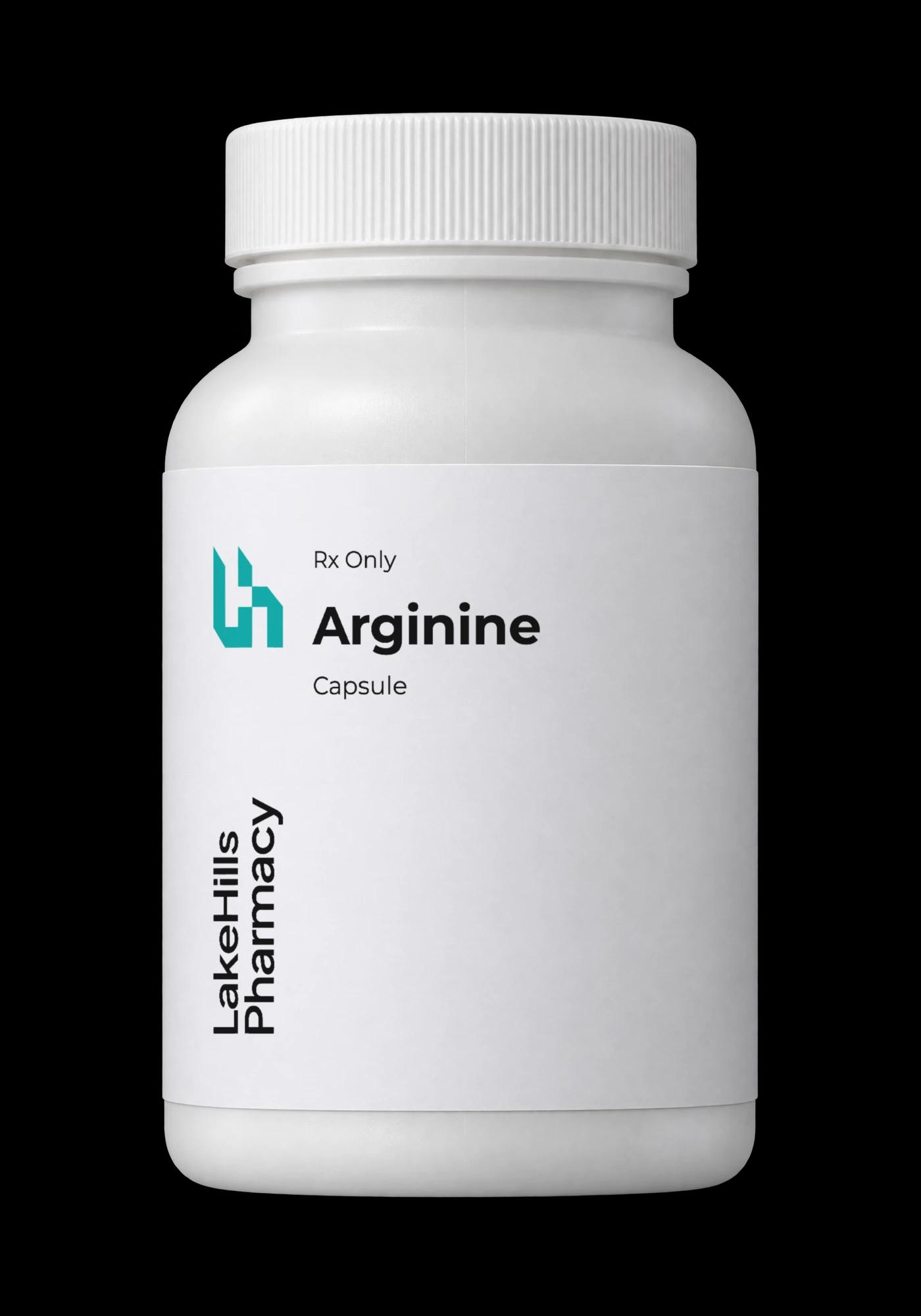
- Active ingredients
- Dosage form
- Capsule
- Route
- Oral
- Care area
- Drug class
- Amino acid
- DEA schedule
- Non-controlled


Compounded and dispensed by an NABP-accredited, LegitScript-certified pharmacy. Verify accreditation (opens in a new tab)
About compounded medications
All formulations are patient-specific prescriptions compounded by Lake Hills Pharmacy under FDA section 503A. Individual ingredients are FDA-approved; compounded products are not reviewed by the FDA for safety, effectiveness, or quality. For licensed healthcare providers only.
Available Dosage Strengths
Strengths are compounded to the prescriber's order.
Clinical information
Product Overview
L-Arginine Capsule is an oral, nonsterile capsule containing L-arginine, a conditionally essential amino acid. Lake Hills Pharmacy compounds the preparation as a 503A pharmacy, pursuant to a patient-specific prescription.
No FDA-approved oral arginine drug product exists. The only FDA-approved arginine product is arginine hydrochloride injection (R-Gene 10), labeled for intravenous use as a diagnostic aid to assess pituitary growth hormone reserve. Prescribers use compounded oral L-arginine capsules when they determine a patient-specific need.
Active Ingredients & Strengths
- L-arginine (oral capsule).
Strength is set on each prescription; contact Lake Hills Pharmacy for available strengths.
Dosing & Administration
Route: oral. No FDA-labeled dose exists for this route; dosing is individualized by the prescriber. Take as prescribed.
The prescriber sets the dose, frequency and duration on each prescription. Gastrointestinal intolerance tends to increase with larger single doses; dividing the daily amount is at the prescriber's discretion.
Key Safety Information
- Avoid after a recent or acute myocardial infarction. A randomized trial of oral L-arginine after acute myocardial infarction was stopped early because of excess deaths in the arginine group.
- Nitrates and riociguat: additive vasodilation and hypotension; avoid combination unless the prescriber directs otherwise.
- PDE5 inhibitors, alpha-blockers and other antihypertensives: additive blood-pressure lowering; monitor for hypotension.
- Potassium-sparing diuretics, ACE inhibitors, ARBs and renal or hepatic impairment: arginine can raise serum potassium; monitor potassium.
- Hypersensitivity to arginine or capsule components. Use caution in patients with a history of herpes simplex recurrences, as arginine supports herpesvirus replication in vitro.
- Common adverse effects are gastrointestinal: nausea, abdominal cramping, bloating and diarrhea.
Storage, Stability & BUD
Storage: controlled room temperature, 20–25°C (68–77°F), in a tightly closed container protected from moisture.
Beyond-use date: per the prescription label.
USP default BUD for this dosage form: 180 days at controlled room temperature (USP <795> nonsterile solid).
Lake Hills may assign extended dating based on its own stability data.
Patient Counseling
Use this medication exactly as your prescriber directs. Do not change the dose, how often you use it, or stop it without talking to your prescriber.
Tell your prescriber about all medicines you take, especially nitrates for chest pain, medicines for erectile dysfunction, blood-pressure medicines and potassium supplements or potassium-sparing diuretics.
Tell your prescriber if you have had a recent heart attack, kidney or liver disease, or frequent cold sores.
Get up slowly if you feel dizzy or lightheaded. Report fainting, severe stomach upset or diarrhea, or signs of an allergic reaction such as rash, swelling or trouble breathing.
References
- R-Gene 10 (arginine hydrochloride injection) Prescribing Information, Pfizer.
- Natural Medicines Comprehensive Database, L-Arginine monograph.
- USP General Chapter <795> Pharmaceutical Compounding—Nonsterile Preparations.
Active ingredients
L-Arginine
Amino acid
Overview
L-arginine is a conditionally essential amino acid obtained from the diet and synthesized endogenously from citrulline. It is the substrate for nitric oxide synthase and a precursor of urea, ornithine, creatine, polyamines and agmatine.
The only FDA-approved arginine drug product is arginine hydrochloride injection 10% (R-Gene 10), for intravenous use. No FDA-approved oral arginine drug product exists; oral L-arginine is otherwise sold as a dietary supplement.
Indications & Uses
R-Gene 10 (arginine hydrochloride injection) is FDA-labeled as an intravenous stimulant of pituitary growth hormone release, for use as a diagnostic aid when measuring pituitary growth hormone reserve.
There is no FDA-labeled indication or dose for oral L-arginine. Prescribers use compounded oral preparations when they determine a patient-specific need; dosing is individualized by the prescriber.
Mechanism of Action
Nitric oxide synthase converts L-arginine to nitric oxide and citrulline; nitric oxide activates soluble guanylate cyclase, raising cGMP and relaxing vascular smooth muscle. Arginase converts arginine to ornithine and urea in the urea cycle. Arginine decarboxylase yields agmatine, and peptidyl-arginine deiminases convert protein arginine residues to citrulline.
Given intravenously, arginine stimulates release of growth hormone, prolactin, insulin and glucagon. This secretagogue response is the basis of the labeled diagnostic use.
Pharmacokinetics
Oral absorption occurs in the small intestine by cationic amino acid transporters. Oral bioavailability is low and variable, roughly 20% in pharmacokinetic studies, because of extensive first-pass metabolism by intestinal and hepatic arginase. Peak plasma concentrations occur about 1 hour after an oral dose.
The plasma half-life is about 1 to 2 hours. Arginine is metabolized mainly by arginase and nitric oxide synthase; it is filtered by the kidney and largely reabsorbed, with urinary loss rising at high plasma concentrations.
Contraindications
- Hypersensitivity to arginine or any component of the preparation. R-Gene 10 labeling also contraindicates use in patients with highly allergic tendencies.
- Avoid after a recent or acute myocardial infarction (see Warnings & Precautions).
Warnings & Precautions
- Post-myocardial infarction: a randomized trial of oral L-arginine added to standard care after acute myocardial infarction was stopped early because of excess deaths in the arginine group. Avoid after recent MI.
- Hyperkalemia: arginine shifts potassium out of cells; life-threatening hyperkalemia has been reported with arginine hydrochloride, particularly in renal or hepatic impairment.
- Acid–base: arginine hydrochloride carries a chloride load and can cause hyperchloremic metabolic acidosis. Pediatric overdosage of the injection has caused cerebral edema and death.
- Hypotension: additive vasodilation with nitrates, PDE5 inhibitors and antihypertensives.
- Herpes simplex: arginine supports herpesvirus replication in vitro; use caution in patients with frequent recurrences.
- Glucose: arginine stimulates insulin and glucagon release; monitor glucose in patients with diabetes.
Drug Interactions
- Nitrates and riociguat: additive hypotension; avoid unless the prescriber determines otherwise.
- PDE5 inhibitors, alpha-blockers and antihypertensives: additive blood-pressure lowering.
- Potassium-sparing diuretics, ACE inhibitors, ARBs and potassium supplements: increased risk of hyperkalemia.
- Insulin and other antidiabetic agents: possible changes in glucose; monitor.
- Anticoagulants and antiplatelets: a theoretical additive effect on platelet function; monitor in combination.
Adverse Effects
Oral: nausea, abdominal pain or cramping, bloating and diarrhea are reported, mostly dose-related. Hypotension, flushing and headache can occur. Hypersensitivity, including airway reactions, is uncommon.
Intravenous (arginine hydrochloride): flushing, nausea, vomiting, headache, numbness, local irritation and extravasation injury at the infusion site, hyperkalemia and metabolic acidosis.
Pregnancy & Lactation
Arginine is a normal dietary amino acid, but the safety of supplemental or compounded doses in pregnancy has not been established, and animal reproduction studies of R-Gene 10 have not been conducted. Use in pregnancy is at the prescriber's discretion after weighing risk and benefit.
Arginine is a normal component of human milk. The effect of supplemental maternal doses on the breastfed infant has not been studied.
Monitoring
Blood pressure and symptoms of hypotension, especially with vasodilators or antihypertensives. Serum potassium and renal function in renal or hepatic impairment or with potassium-raising drugs. Blood glucose in patients with diabetes. Gastrointestinal tolerance.
References
- R-Gene 10 (arginine hydrochloride injection) Prescribing Information, Pfizer.
- Natural Medicines Comprehensive Database, L-Arginine monograph.
- Goodman & Gilman's The Pharmacological Basis of Therapeutics, McGraw Hill.
Ask a pharmacist
Are compounded medications FDA approved?
All formulations are patient-specific prescriptions compounded by Lake Hills Pharmacy under FDA section 503A. Individual ingredients are FDA-approved; compounded products are not reviewed by the FDA for safety, effectiveness, or quality. For licensed healthcare providers only.
How do I get a prescription filled here?
You can have your doctor send prescriptions to us any time. We also transfer your medications from another pharmacy. Our pharmacy accepts all major insurance plans.
Can you ship this medication to my state?
It depends on the medication and on your state. Whether we can dispense or ship a medication to you depends on the laws and board of pharmacy rules of your state and on our licensure there. We confirm availability when we receive a prescription.
These answers cover the basics. For anything about a formula, a strength or a prescription, contact our pharmacists.
Mon - Fri: 8:30am - 6:30pm CTSaturday: 9:00am - 2:00pm CTSunday: Closed
12005 Bee Cave Rd, Suite 1-A, Austin, TX 78738