
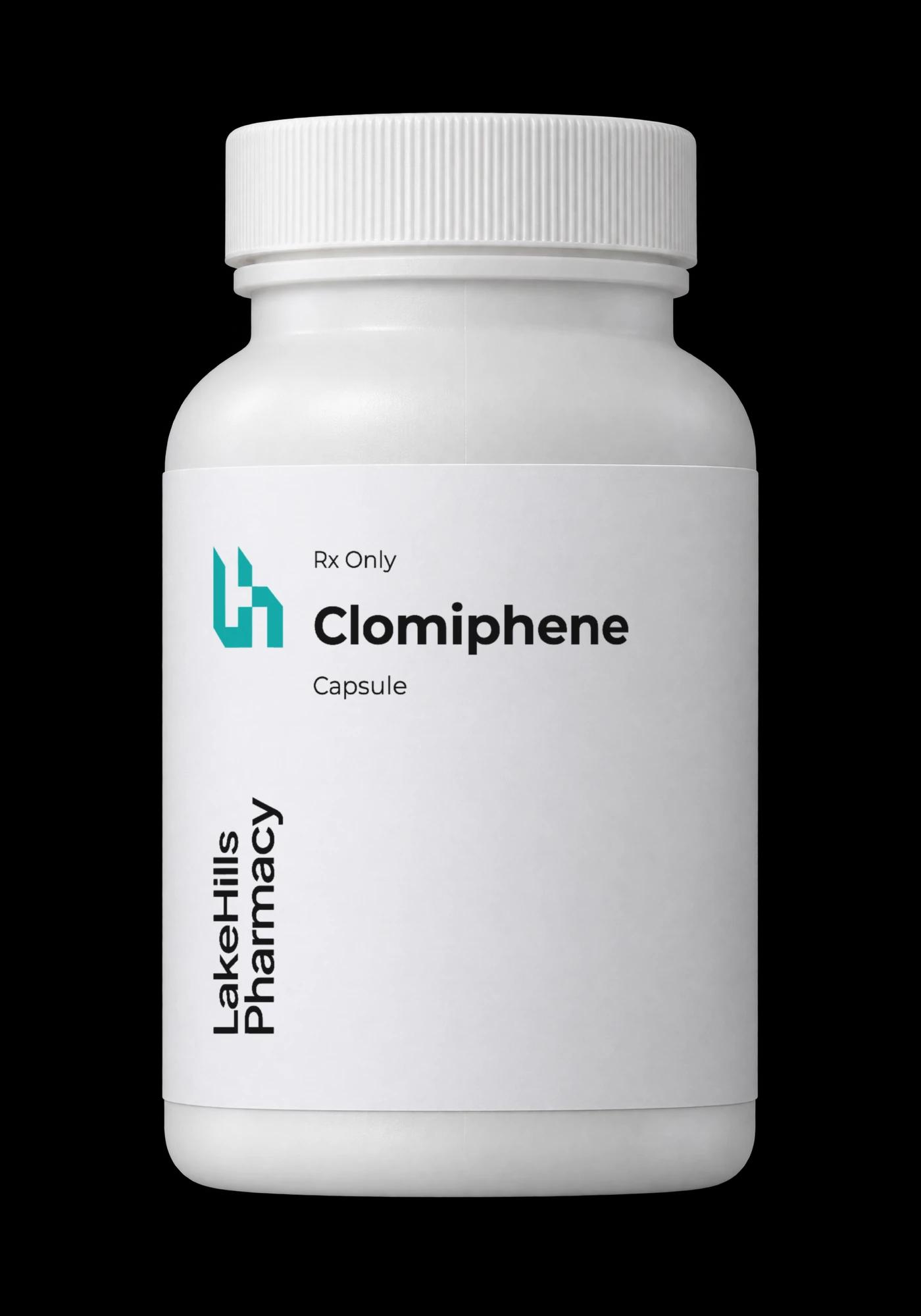
- Active ingredients
- Dosage form
- Capsule
- Route
- Oral
- Care area
- Drug class
- SERM
- DEA schedule
- Non-controlled
- Storage
- Room temperature


Compounded and dispensed by an NABP-accredited, LegitScript-certified pharmacy. Verify accreditation (opens in a new tab)
About compounded medications
All formulations are patient-specific prescriptions compounded by Lake Hills Pharmacy under FDA section 503A. Individual ingredients are FDA-approved; compounded products are not reviewed by the FDA for safety, effectiveness, or quality. For licensed healthcare providers only.
Available Dosage Strengths
Capsule
12.5 mg
25 mg
45 mg
Clinical information
Product Overview
Clomiphene Citrate Capsules are nonsterile oral capsules compounded by Lake Hills Pharmacy, a 503A pharmacy, pursuant to a patient-specific prescription. Clomiphene citrate is a nonsteroidal selective estrogen receptor modulator (SERM). FDA-approved clomiphene citrate 50 mg tablets (Clomid and generics) are indicated for the treatment of ovulatory dysfunction in women desiring pregnancy.
Prescribers also use compounded clomiphene off-label in men with secondary (hypogonadotropic) hypogonadism or male-factor infertility, to raise endogenous LH, FSH and testosterone. Compounded capsules provide strengths that differ from the 50 mg tablet.
Active Ingredients & Strengths
Active ingredient: clomiphene citrate.
Available strengths: 12.5 mg, 25 mg and 45 mg capsules, dispensed by the capsule in the quantity on the prescription.
Dosing & Administration
Route: oral. Use as prescribed.
Ovulatory dysfunction in women: FDA labeling gives 50 mg to 100 mg daily, taken as 5-day courses; doses above 100 mg daily and treatment beyond about six courses are not recommended. Treatment follows a gynecologic evaluation and exclusion of pregnancy.
Use in men: no FDA-labeled dose exists for men; dosing is individualized by the prescriber and guided by laboratory monitoring.
Key Safety Information
- Contraindications: pregnancy; hypersensitivity; liver disease or a history of liver dysfunction; abnormal uterine bleeding of undetermined origin; ovarian cysts or enlargement not due to polycystic ovary syndrome; uncontrolled thyroid or adrenal dysfunction; an organic intracranial lesion such as a pituitary tumor.
- Visual symptoms (blurring, spots, flashes or afterimages) can occur. Stop treatment and arrange an ophthalmologic evaluation; visual symptoms can make driving hazardous.
- Women: ovarian hyperstimulation syndrome, ovarian enlargement and multiple pregnancy can occur; the lowest dose that produces ovulation is used.
- Men: estradiol can rise, with breast tenderness or gynecomastia; hematocrit and mood changes can occur. Thromboembolic events have been reported rarely with clomiphene.
- Hypertriglyceridemia, sometimes with pancreatitis, has been reported; use caution with a personal or family history of high triglycerides.
Storage, Stability & BUD
Storage: room temperature.
Beyond-use date: per the prescription label.
USP default BUD for this dosage form: 180 days at controlled room temperature (USP <795>, nonsterile solid dosage form).
Lake Hills may assign extended dating based on its own stability data.
Patient Counseling
- Take clomiphene exactly as your prescriber directs. Do not change the dose or schedule on your own.
- Stop and call your prescriber right away for blurred vision, spots or flashes of light. Avoid driving or hazardous tasks until you know how the medicine affects you.
- Women: report pelvic or abdominal pain, bloating or rapid weight gain promptly, and contact your prescriber if you may be pregnant.
- Men: report breast tenderness or swelling, mood changes, or leg pain or swelling.
- Seek emergency care for chest pain, sudden shortness of breath, or sudden weakness on one side of the body.
- Keep your laboratory appointments. Store the capsules at room temperature and discard them after the beyond-use date.
References
- Clomid (clomiphene citrate tablets USP) Prescribing Information.
- Evaluation and Management of Testosterone Deficiency: AUA Guideline. American Urological Association.
- USP General Chapter <795> Pharmaceutical Compounding: Nonsterile Preparations.
Active ingredients
Clomiphene Citrate
SERM
Overview
Clomiphene citrate is a nonsteroidal triphenylethylene selective estrogen receptor modulator (SERM). It is a mixture of two geometric isomers, enclomiphene (trans) and zuclomiphene (cis), with zuclomiphene making up roughly 30% to 50%. It is FDA approved as 50 mg oral tablets (Clomid and generics). Compounded oral preparations are made pursuant to patient-specific prescriptions.
Indications & Uses
FDA-labeled indication: treatment of ovulatory dysfunction in women desiring pregnancy, including those with polycystic ovary syndrome, after exclusion of pregnancy, ovarian cysts, abnormal uterine bleeding and liver disease, and with adequate endogenous estrogen. It is not indicated for primary pituitary or ovarian failure.
Prescribers also use clomiphene off-label in men with secondary (hypogonadotropic) hypogonadism and in male-factor infertility, to raise endogenous gonadotropins and testosterone while maintaining spermatogenesis. Lake Hills also prepares clomiphene in combination with anastrozole or DHEA on prescription.
Mechanism of Action
Clomiphene competes with estradiol at estrogen receptors in the hypothalamus, blocking negative feedback. GnRH pulse frequency rises, and the pituitary releases more LH and FSH. In women, this promotes follicular development and ovulation; in men, LH stimulates testicular testosterone production and FSH supports spermatogenesis.
Clomiphene also has weak estrogen agonist activity, mainly attributed to zuclomiphene, and antiestrogenic effects on the endometrium and cervical mucus. It has no androgenic, antiandrogenic or progestational activity.
Pharmacokinetics
Clomiphene is readily absorbed orally. It is metabolized in the liver, with CYP2D6 forming active hydroxylated metabolites of enclomiphene and CYP3A4 also contributing, and is excreted mainly in feces via bile with enterohepatic recirculation. The elimination half-life is about 5 days. Zuclomiphene is eliminated more slowly and accumulates with repeated dosing; radiolabeled drug has been detected in feces up to 6 weeks after a dose.
Contraindications
- Pregnancy.
- Hypersensitivity to clomiphene or any component.
- Liver disease or a history of liver dysfunction.
- Abnormal uterine bleeding of undetermined origin.
- Ovarian cysts or enlargement not due to polycystic ovary syndrome.
- Uncontrolled thyroid or adrenal dysfunction.
- An organic intracranial lesion such as a pituitary tumor.
Warnings & Precautions
- Visual symptoms: blurring, scotomata, phosphenes and afterimages can occur, and may be prolonged or persist. Discontinue and arrange an ophthalmologic evaluation; visual symptoms can make driving or operating machinery hazardous.
- Ovarian hyperstimulation syndrome and ovarian enlargement: use the lowest dose that produces ovulation, and withhold further courses until ovaries return to baseline size.
- Multiple pregnancy, mostly twins, is more frequent than in spontaneous conception.
- Prolonged use: an association with ovarian tumors has been suggested with extended treatment; labeling does not recommend use beyond about six courses.
- Hypertriglyceridemia, sometimes with pancreatitis, has been reported, particularly with pre-existing or familial hypertriglyceridemia or higher doses.
- Men: estradiol rises with gonadotropin stimulation and can cause breast tenderness or gynecomastia; hematocrit can rise; mood changes and, rarely, thromboembolic events have been reported.
- Use caution in patients with depression, psychosis or a history of thromboembolic disease.
Drug Interactions
No formal interaction studies are described in labeling. CYP2D6 inhibitors (for example paroxetine, fluoxetine, bupropion) and CYP2D6 genotype can alter exposure to clomiphene's active metabolites. Exogenous testosterone and anabolic steroids suppress the hypothalamic-pituitary-gonadal axis that clomiphene acts on.
In men, clomiphene is sometimes prescribed together with anastrozole, which lowers estradiol, or with DHEA, a sex-steroid precursor; combined use calls for monitoring of testosterone and estradiol rather than avoidance.
Adverse Effects
Women: hot flashes, ovarian enlargement, abdominal or pelvic discomfort and bloating, nausea and vomiting, breast discomfort, headache, abnormal uterine bleeding, visual symptoms and thinning of cervical mucus. Men: breast tenderness or gynecomastia, mood changes or irritability, headache, visual symptoms, acne and increased hematocrit. Rare: hepatic enzyme elevation, pancreatitis with hypertriglyceridemia, thromboembolism.
Pregnancy & Lactation
Contraindicated in pregnancy; pregnancy is excluded before each treatment course. Animal studies showed fetal harm at high doses. It is not known whether clomiphene is excreted in human milk, and clomiphene can reduce lactation; it is generally avoided during breastfeeding.
Monitoring
Women: pregnancy test and pelvic examination or ultrasound before each course, confirmation of ovulation, baseline liver function, and symptoms of ovarian enlargement or visual change. Men: total testosterone, estradiol, LH and FSH, hematocrit, lipids, liver function, PSA as appropriate for age, semen analysis when fertility is a goal, and mood and visual symptoms.
References
- Clomid (clomiphene citrate tablets USP) Prescribing Information.
- Evaluation and Management of Testosterone Deficiency: AUA Guideline. American Urological Association.
- AHFS Drug Information. American Society of Health-System Pharmacists.
Ask a pharmacist
Are compounded medications FDA approved?
All formulations are patient-specific prescriptions compounded by Lake Hills Pharmacy under FDA section 503A. Individual ingredients are FDA-approved; compounded products are not reviewed by the FDA for safety, effectiveness, or quality. For licensed healthcare providers only.
How do I get a prescription filled here?
You can have your doctor send prescriptions to us any time. We also transfer your medications from another pharmacy. Our pharmacy accepts all major insurance plans.
Can you ship this medication to my state?
It depends on the medication and on your state. Whether we can dispense or ship a medication to you depends on the laws and board of pharmacy rules of your state and on our licensure there. We confirm availability when we receive a prescription.
These answers cover the basics. For anything about a formula, a strength or a prescription, contact our pharmacists.
Mon - Fri: 8:30am - 6:30pm CTSaturday: 9:00am - 2:00pm CTSunday: Closed
12005 Bee Cave Rd, Suite 1-A, Austin, TX 78738