
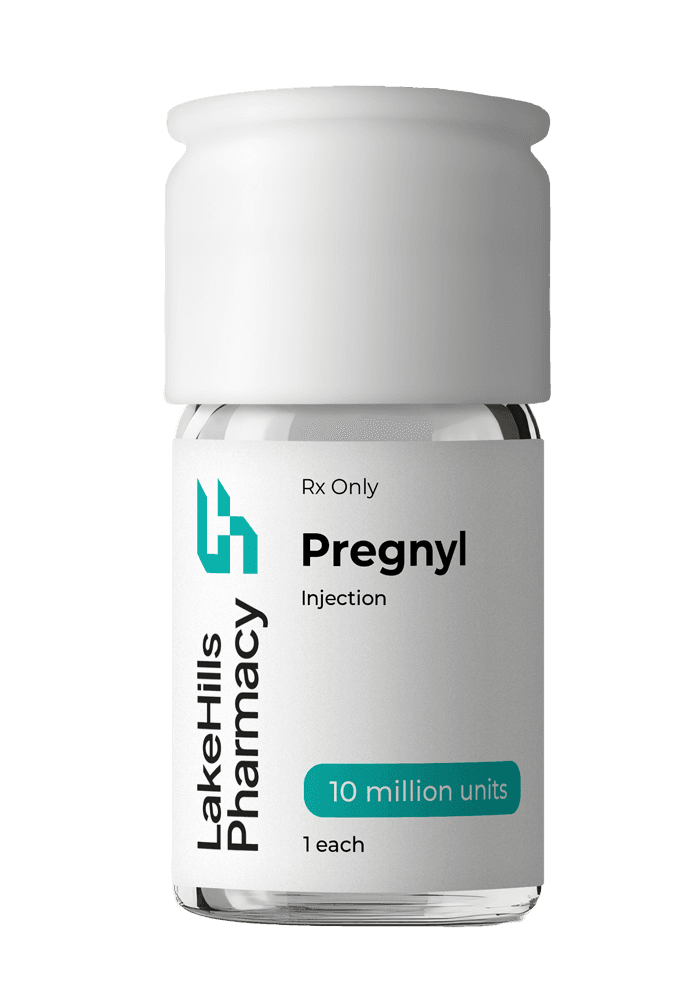
- Active ingredients
- Dosage form
- Injection
- Route
- Intramuscular injection
- Care area
- Drug class
- Gonadotropin
- DEA schedule
- Non-controlled
- Sterile preparation
- Yes


Compounded and dispensed by an NABP-accredited, LegitScript-certified pharmacy. Verify accreditation (opens in a new tab)
About compounded medications
All formulations are patient-specific prescriptions compounded by Lake Hills Pharmacy under FDA section 503A. Individual ingredients are FDA-approved; compounded products are not reviewed by the FDA for safety, effectiveness, or quality. For licensed healthcare providers only.
Available Dosage Strengths
Injection
10,000 USP units
Unit size: 1 multiple-dose vial
Clinical information
Boxed Warning
Urinary chorionic gonadotropin labeling carries a prominent statement that hCG has not been shown to be of benefit as adjunctive therapy for obesity. There is no substantial evidence that it increases weight loss beyond that resulting from caloric restriction, causes a more attractive or normal distribution of fat, or decreases the hunger and discomfort associated with calorie-restricted diets.
Product Overview
Pregnyl (chorionic gonadotropin for injection, USP) is a sterile, lyophilized human chorionic gonadotropin (hCG) for intramuscular injection. This is a manufactured, FDA-approved product dispensed by Lake Hills Pharmacy; it is not compounded.
Pregnyl is FDA labeled for prepubertal cryptorchidism not due to anatomical obstruction, for selected cases of hypogonadotropic hypogonadism (hypogonadism secondary to pituitary deficiency) in males, and for induction of ovulation and pregnancy in anovulatory infertile women whose anovulation is secondary and not due to primary ovarian failure, and who have been appropriately pretreated with human gonadotropins.
Active Ingredients & Strengths
- Chorionic gonadotropin 10,000 USP units per multi-dose vial, 1 each, supplied with 10 mL of solvent (water for injection with sodium chloride and benzyl alcohol as a preservative); the solvent is not for use in newborns. Each multiple-dose vial is for use in one patient only.
Dosing & Administration
Dose and schedule are set by the prescriber, as prescribed. Pregnyl is labeled for intramuscular use only; subcutaneous administration is not labeled and is used only at the prescriber's direction.
For reference, labeled regimens for male hypogonadotropic hypogonadism and prepubertal cryptorchidism range from 500 to 5,000 USP units IM per injection, given two to three times weekly or every second day depending on the indication and regimen; for ovulation induction, 5,000 to 10,000 USP units IM once, one day after the last dose of human gonadotropins.
Key Safety Information
- Labeling statement: hCG has not been shown to be of benefit as adjunctive therapy for obesity. There is no substantial evidence that it increases weight loss beyond that from caloric restriction, causes a more attractive or normal fat distribution, or decreases the hunger and discomfort of calorie-restricted diets.
- Pregnancy: Pregnyl is not indicated in pregnancy. It may be used for luteal-phase support but is discontinued once pregnancy is confirmed.
- Contraindications (Pregnyl labeling): prior hypersensitivity to human gonadotropins, including hCG, or any excipient; high serum FSH indicating primary gonadal failure in women; uncontrolled non-gonadal endocrinopathies (thyroid, adrenal or pituitary); tumors of the hypothalamus or pituitary, of the ovary, breast or uterus in females, or of the breast or prostate in males; malformations of the reproductive organs incompatible with pregnancy; uterine fibroids incompatible with pregnancy; abnormal vaginal bleeding of undetermined origin.
- Anaphylaxis has been reported. Ovulation induction carries risks of ovarian hyperstimulation syndrome, ovarian enlargement and torsion, pulmonary and vascular complications including thromboembolism, multiple pregnancy, ectopic pregnancy and spontaneous abortion. Use only by prescribers experienced in infertility care.
- hCG can induce precocious puberty in boys treated for cryptorchidism; discontinue if signs occur. Androgen-induced fluid retention: use with caution in cardiac or renal disease, hypertension, epilepsy, migraine or asthma.
- Common adverse effects include headache, irritability, restlessness, depression, fatigue, edema, gynecomastia and injection-site pain. hCG causes positive pregnancy tests.
Storage, Stability & BUD
- Storage: before reconstitution, store at 15°C to 25°C (59°F to 77°F); after reconstitution, refrigerate at 2°C to 8°C (36°F to 46°F), do not freeze, and discard after 60 days, per the Pregnyl label.
- Expiration: this is a manufactured product, so USP compounding beyond-use dates and extended dating do not apply. The manufacturer's expiration date applies to the unreconstituted vial.
- After first puncture, follow the in-use dating on the label.
Patient Counseling
Use this medication exactly as your prescriber directs. Do not change the amount or how often you use it without talking to your prescriber.
- Inject into a muscle using the technique your prescriber or clinic taught you, and use a new sterile needle and syringe each time.
- Women: seek care right away for severe pelvic or abdominal pain, rapid weight gain, abdominal swelling, nausea or vomiting, decreased urination or shortness of breath.
- Call your prescriber for leg swelling or pain, chest pain, breast enlargement, mood changes or signs of an allergic reaction.
References
- Pregnyl (chorionic gonadotropin for injection, USP) Prescribing Information.
Active ingredients
Human Chorionic Gonadotropin
Gonadotropin
Overview
Human chorionic gonadotropin (hCG) is a glycoprotein hormone produced by the placenta, with actions nearly identical to luteinizing hormone. FDA-approved urinary-derived products are Pregnyl and Novarel (chorionic gonadotropin for injection, USP, for intramuscular use) and generic chorionic gonadotropin; recombinant choriogonadotropin alfa (Ovidrel) is approved for subcutaneous use in assisted reproduction.
Indications & Uses
- Prepubertal cryptorchidism not due to anatomical obstruction.
- Selected cases of hypogonadotropic hypogonadism (hypogonadism secondary to pituitary deficiency) in males.
- Induction of ovulation and pregnancy in anovulatory infertile women whose anovulation is secondary and not due to primary ovarian failure, and who have been appropriately pretreated with human gonadotropins.
- Choriogonadotropin alfa: final follicular maturation and early luteinization in assisted reproductive technology, and ovulation induction.
Mechanism of Action
hCG binds the luteinizing hormone/chorionic gonadotropin receptor. In males it stimulates Leydig cells to produce testosterone and other androgens, supporting spermatogenesis and testicular descent. In females it triggers final follicular maturation and ovulation, and supports the corpus luteum and progesterone production.
Pharmacokinetics
hCG is not active orally and is given by intramuscular or subcutaneous injection. After IM injection, peak serum levels occur within about 6 hours. Elimination is biphasic, with a terminal half-life of roughly one day; a portion is excreted unchanged in urine. Testosterone rises within days of dosing in males.
Contraindications
Current Pregnyl labeling (Rev 03/2025):
- Prior hypersensitivity to human gonadotropins, including hCG, or any excipient.
- High serum FSH indicating primary gonadal failure in women.
- Uncontrolled non-gonadal endocrinopathies (thyroid, adrenal or pituitary).
- Tumors of the hypothalamus or pituitary; tumors of the ovary, breast or uterus in females, or of the breast or prostate in males.
- Malformations of the reproductive organs incompatible with pregnancy, or uterine fibroids incompatible with pregnancy.
- Abnormal vaginal bleeding of undetermined origin.
Novarel labeling (older format) lists precocious puberty, prostatic carcinoma or other androgen-dependent neoplasm, and prior allergic reaction to hCG. Current Pregnyl labeling treats precocious puberty as a precaution.
Warnings & Precautions
- Use by prescribers experienced in managing infertility or the labeled endocrine disorders.
- Anaphylaxis and other hypersensitivity reactions have been reported.
- Ovarian hyperstimulation syndrome (OHSS), ovarian enlargement and cyst rupture can follow ovulation induction; OHSS can progress rapidly and cause fluid shifts, thromboembolism and organ dysfunction.
- Multiple pregnancy occurs more often with ovulation induction.
- Arterial thromboembolism has been reported with hCG used with menotropins.
- hCG can induce precocious puberty in boys treated for cryptorchidism; stop if signs occur.
- Androgen-induced fluid retention: use with caution in cardiac or renal disease, hypertension, epilepsy, migraine or asthma.
- With ovulation induction, ovarian torsion, ectopic pregnancy and spontaneous abortion are also described in labeling.
Drug Interactions
No formal drug interaction studies are described in labeling. Use with menotropins, follitropins or clomiphene adds to the risk of OHSS and multiple pregnancy. hCG produces positive serum and urine pregnancy tests and can interfere with hCG-based tumor markers for some time after dosing.
Adverse Effects
Headache, irritability, restlessness, depression, fatigue, edema, precocious puberty, gynecomastia, injection-site pain and hypersensitivity reactions. In women undergoing ovulation induction: OHSS, ovarian cysts, multiple gestation and thromboembolic events.
Pregnancy & Lactation
Current Pregnyl labeling (Rev 03/2025) states that hCG is not indicated in pregnancy; it may be used for luteal-phase support and is discontinued once pregnancy is confirmed. Older-format Novarel labeling also cautions that hCG may cause fetal harm when given to a pregnant woman. Follow current product labeling on use in pregnancy. It is not known whether exogenous hCG passes into breast milk; use during lactation only if the prescriber judges it necessary.
Monitoring
Males: serum testosterone, signs of virilization or precocious puberty in boys, semen analysis when fertility is the goal, and breast changes. Females undergoing ovulation induction: ultrasound follicle monitoring, serum estradiol, and signs of OHSS such as abdominal pain, distension and rapid weight gain.
References
- Pregnyl (chorionic gonadotropin for injection, USP) Prescribing Information.
- Novarel (chorionic gonadotropin for injection, USP) Prescribing Information, Ferring Pharmaceuticals.
- Ovidrel (choriogonadotropin alfa injection) Prescribing Information, EMD Serono.
Ask a pharmacist
Are compounded medications FDA approved?
All formulations are patient-specific prescriptions compounded by Lake Hills Pharmacy under FDA section 503A. Individual ingredients are FDA-approved; compounded products are not reviewed by the FDA for safety, effectiveness, or quality. For licensed healthcare providers only.
How do I get a prescription filled here?
You can have your doctor send prescriptions to us any time. We also transfer your medications from another pharmacy. Our pharmacy accepts all major insurance plans.
Can you ship this medication to my state?
It depends on the medication and on your state. Whether we can dispense or ship a medication to you depends on the laws and board of pharmacy rules of your state and on our licensure there. We confirm availability when we receive a prescription.
These answers cover the basics. For anything about a formula, a strength or a prescription, contact our pharmacists.
Mon - Fri: 8:30am - 6:30pm CTSaturday: 9:00am - 2:00pm CTSunday: Closed
12005 Bee Cave Rd, Suite 1-A, Austin, TX 78738