
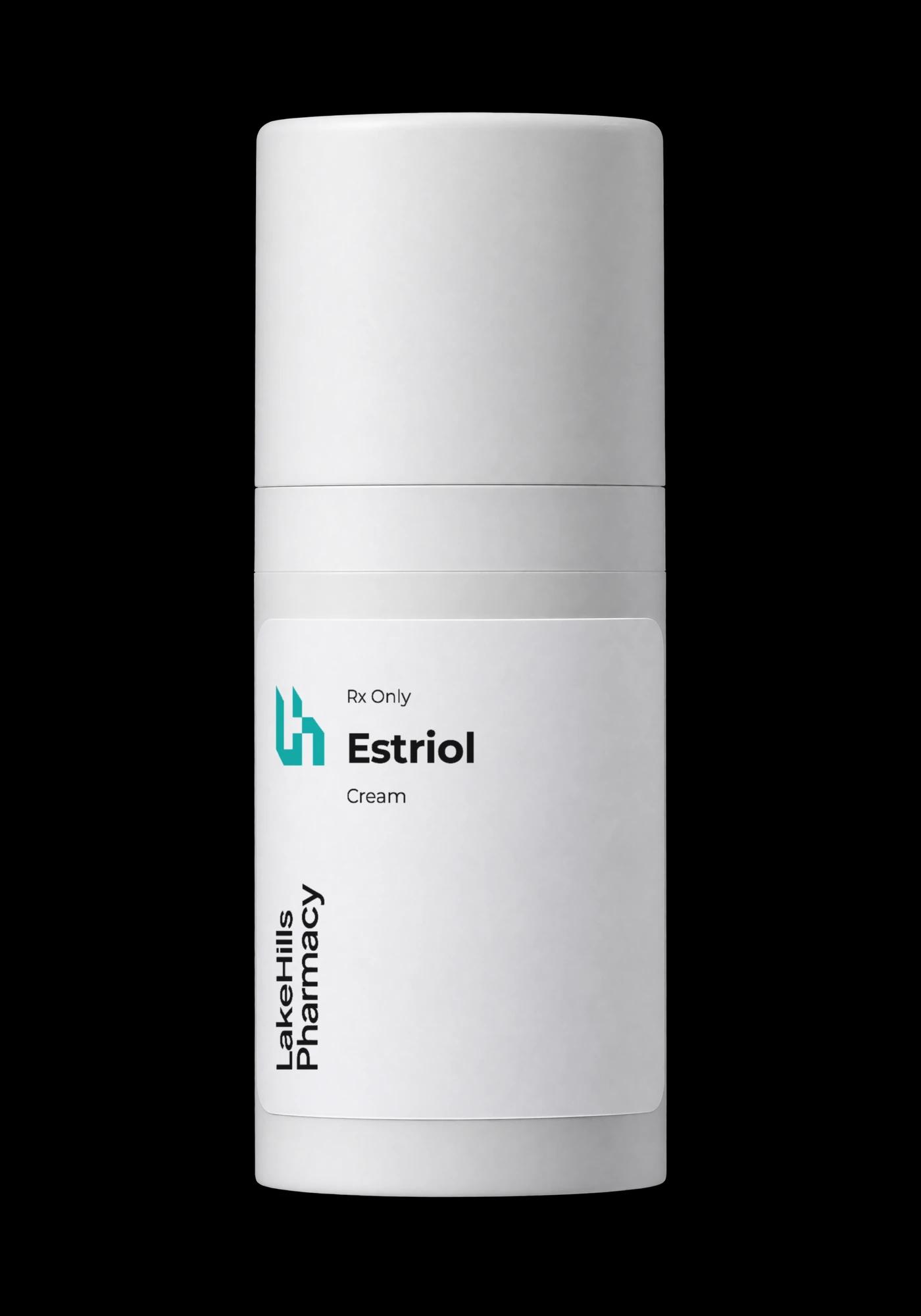
- Active ingredients
- Dosage form
- Cream
- Route
- Topical
- Care area
- Drug class
- Estrogen
- DEA schedule
- Non-controlled
- Storage
- Room temperature


Compounded and dispensed by an NABP-accredited, LegitScript-certified pharmacy. Verify accreditation (opens in a new tab)
About compounded medications
All formulations are patient-specific prescriptions compounded by Lake Hills Pharmacy under FDA section 503A. Individual ingredients are FDA-approved; compounded products are not reviewed by the FDA for safety, effectiveness, or quality. For licensed healthcare providers only.
Available Dosage Strengths
Cream
0.5 mg/
mL 1 mg/
mL 2 mg/
mL 3 mg/
mL 4 mg/
mL 5 mg/
mL 6 mg/
mL 7 mg/
mL 8 mg/
mL 9 mg/
mL 10 mg/
mL
Clinical information
Product Overview
Estriol Cream is a topical estrogen cream that Lake Hills Pharmacy compounds as a 503A pharmacy, pursuant to a patient-specific prescription. Estriol is a naturally occurring estrogen with lower estrogen-receptor potency than estradiol. There is no FDA-approved estriol product in the United States, so no FDA-labeled indication or dose exists for estriol. Prescribers use compounded estriol cream in women's hormone therapy, including for genitourinary symptoms of menopause.
Estriol is an estrogen, and the safety considerations of the estrogen class apply to it.
Active Ingredients & Strengths
- Active ingredient: estriol.
- Available strengths: 0.5, 1, 2, 3, 4, 5, 6, 7, 8, 9 or 10 mg/mL cream. Container size is set on each prescription.
- Route: topical.
Dosing & Administration
No FDA-labeled dose exists for this route; dosing is individualized by the prescriber. Apply the cream as prescribed, to the area and in the amount the prescriber directs.
Women with a uterus who use estrogen therapy should be evaluated for a progestogen. Prescribers should reassess the need for continued therapy periodically.
Key Safety Information
- Boxed warning (estrogen class labeling applied by analogy; there is no FDA-approved estriol product): endometrial cancer. An estrogen used without a progestogen in a woman with a uterus increases the risk of endometrial cancer; adding a progestogen reduces the risk. Evaluate persistent or recurring abnormal genital bleeding promptly. FDA's 2026 menopausal hormone therapy labeling revision removed cardiovascular disease, breast cancer and probable dementia from the boxed warning; stroke, venous thromboembolism and breast cancer remain under Warnings & Precautions.
- Starting hormone therapy for moderate to severe vasomotor symptoms can be considered for women under 60 or within 10 years of menopause. In the Women's Health Initiative, estrogen-alone therapy increased the risks of stroke and deep vein thrombosis, and estrogen plus progestin therapy increased the risks of stroke, deep vein thrombosis, pulmonary embolism and invasive breast cancer.
- Contraindications for estrogens include undiagnosed abnormal genital bleeding, known, suspected or past breast cancer, estrogen-dependent neoplasia, active or past venous thromboembolism or arterial thromboembolic disease, liver impairment or disease, known protein C, protein S or antithrombin deficiency or other thrombophilia, known anaphylactic reaction or angioedema with the ingredients, and known or suspected pregnancy.
- Topical estrogen can transfer to others through skin contact. Children and pets exposed to treated skin may show signs of estrogen exposure.
- Report any abnormal vaginal bleeding, breast changes, leg pain or swelling, chest pain, shortness of breath, sudden headache or vision change.
- Interactions: CYP3A4 inducers (such as rifampin, carbamazepine and St. John's wort) may lower and CYP3A4 inhibitors (such as ketoconazole, itraconazole and ritonavir) may raise estrogen exposure. Use with other estrogen products adds to total estrogen exposure.
- Common local effects include redness, burning or itching at the application site. Breast tenderness and spotting can occur.
Storage, Stability & BUD
- Storage: room temperature, container tightly closed.
- Beyond-use date: per the prescription label.
- USP default BUD (USP <795>): 35 days at controlled room temperature or refrigerated for a preserved aqueous preparation, 14 days refrigerated for a nonpreserved aqueous preparation, or 90 days for a nonaqueous preparation; the category follows the Lake Hills base and vehicle.
- Lake Hills may assign extended dating based on its own stability data.
Patient Counseling
- Use this medication exactly as your prescriber directs. Do not change the amount or how often you use it without talking to your prescriber.
- Apply only to intact skin in the area your prescriber names. Wash your hands after each application.
- Keep treated skin covered or avoid skin-to-skin contact until the cream has dried, and keep the cream away from children and pets.
- Tell your prescriber right away about vaginal bleeding, breast lumps, chest pain, leg swelling, sudden severe headache or vision changes.
- Do not use this cream if you are pregnant or could be pregnant. Do not use it while breastfeeding unless your prescriber tells you to.
References
- Estrace (estradiol) Prescribing Information (estrogen class labeling).
- USP General Chapter <795> Pharmaceutical Compounding, Nonsterile Preparations.
- USP Estriol monograph, United States Pharmacopeia–National Formulary.
Active ingredients
Estriol
Estrogen
Overview
Estriol (E3) is an endogenous estrogen formed mainly from estradiol and estrone and produced in large amounts by the placenta during pregnancy. It is a weaker estrogen than estradiol. Estriol is not a component of any FDA-approved drug product in the United States; it is approved in some other countries, mainly as vaginal cream or pessaries. In the United States it is a bulk drug substance used in compounded preparations. Lake Hills Pharmacy compounds it, pursuant to patient-specific prescriptions, in estriol/estradiol (Bi-Est) cream and rapid dissolve tablets.
Drug class: estrogen. Non-controlled.
Indications & Uses
No FDA-labeled indication or dose exists. Prescribers use compounded estriol, usually combined with estradiol, for menopausal vasomotor and genitourinary symptoms. A 2020 National Academies report found the clinical evidence for compounded bioidentical hormone preparations limited and noted variable dosing and absorption.
Mechanism of Action
Estriol binds estrogen receptors ER-alpha and ER-beta, with lower affinity and shorter receptor occupancy than estradiol. It produces estrogenic effects in the urogenital tract, endometrium, breast and other tissues; with sufficient dose or frequency it can stimulate endometrial proliferation.
Pharmacokinetics
Orally administered estriol is extensively conjugated (glucuronide and sulfate) in the gut wall and liver, so little unconjugated estriol reaches the circulation; it has a short elimination half-life. Vaginal and transdermal administration avoid first-pass conjugation, and absorption from compounded preparations varies with vehicle, site and patient. Estriol is not appreciably converted to estradiol or estrone and is excreted in urine, mainly as conjugates.
Contraindications
- Undiagnosed abnormal genital bleeding.
- Known, suspected or past breast cancer, or known or suspected estrogen-dependent neoplasia.
- Active or past deep vein thrombosis or pulmonary embolism, or active or past arterial thromboembolic disease (stroke, myocardial infarction).
- Known liver impairment or disease.
- Known protein C, protein S or antithrombin deficiency, or another known thrombophilic disorder.
- Known anaphylactic reaction or angioedema with the drug or its ingredients.
- Known or suspected pregnancy.
Warnings & Precautions
- Estriol has no US prescribing information; estrogen class labeling is applied by analogy. Boxed warning (estrogen-alone products): endometrial cancer. An estrogen used without a progestogen in a woman with a uterus increases the risk of endometrial cancer; adding a progestogen reduces the risk. FDA's 2026 menopausal hormone therapy labeling revision removed cardiovascular disease, breast cancer and probable dementia from the boxed warning; stroke, venous thromboembolism and breast cancer remain under Warnings & Precautions.
- Starting hormone therapy for moderate to severe vasomotor symptoms can be considered for women under 60 or within 10 years of menopause.
- Women with a uterus who receive estriol should also receive a progestogen; evaluate persistent or recurring abnormal genital bleeding.
- Thromboembolic events, gallbladder disease, elevated blood pressure, hypertriglyceridemia and hepatic effects are class warnings for estrogens.
- Exposure from compounded estriol preparations varies; estriol is often combined with estradiol, and the combined estrogen exposure is what matters for safety.
- Secondary exposure: topical estrogen can transfer to children and pets through contact with the application site.
Drug Interactions
- Other estrogen- or hormone-containing products add to estrogen exposure.
- Enzyme inducers (rifampin, carbamazepine, phenobarbital, phenytoin, St. John's wort) may increase estrogen clearance; this is a class interaction and is not well characterized for estriol.
- Thyroid hormone: oral estrogen can raise thyroxine-binding globulin; review thyroid replacement dose.
Adverse Effects
Reported effects are those of estrogens: breast tenderness, vaginal bleeding or spotting, vaginal discharge, nausea, headache and fluid retention, plus local irritation, burning or itching with topical or vaginal use. Serious class effects include endometrial hyperplasia and cancer, thromboembolism and breast cancer.
Pregnancy & Lactation
Estriol has no indication in pregnancy and should not be used in known or suspected pregnancy. Estrogens pass into breast milk and may reduce milk supply; use during breastfeeding is generally avoided.
Monitoring
Reassess the need for therapy periodically. Monitor blood pressure, breast examination and mammography, and abnormal genital bleeding, with endometrial evaluation when indicated in women with a uterus. Serum and salivary estriol measurements are not validated for dose adjustment.
References
- National Academies of Sciences, Engineering, and Medicine. Report on the clinical utility of compounded bioidentical hormone therapy. 2020.
- The 2022 Hormone Therapy Position Statement of The North American Menopause Society. Menopause. 2022.
- Estrace (estradiol tablets, USP) Prescribing Information (estrogen class labeling).
- USP General Chapter <795> Pharmaceutical Compounding: Nonsterile Preparations.
Ask a pharmacist
Are compounded medications FDA approved?
All formulations are patient-specific prescriptions compounded by Lake Hills Pharmacy under FDA section 503A. Individual ingredients are FDA-approved; compounded products are not reviewed by the FDA for safety, effectiveness, or quality. For licensed healthcare providers only.
How do I get a prescription filled here?
You can have your doctor send prescriptions to us any time. We also transfer your medications from another pharmacy. Our pharmacy accepts all major insurance plans.
Can you ship this medication to my state?
It depends on the medication and on your state. Whether we can dispense or ship a medication to you depends on the laws and board of pharmacy rules of your state and on our licensure there. We confirm availability when we receive a prescription.
These answers cover the basics. For anything about a formula, a strength or a prescription, contact our pharmacists.
Mon - Fri: 8:30am - 6:30pm CTSaturday: 9:00am - 2:00pm CTSunday: Closed
12005 Bee Cave Rd, Suite 1-A, Austin, TX 78738