
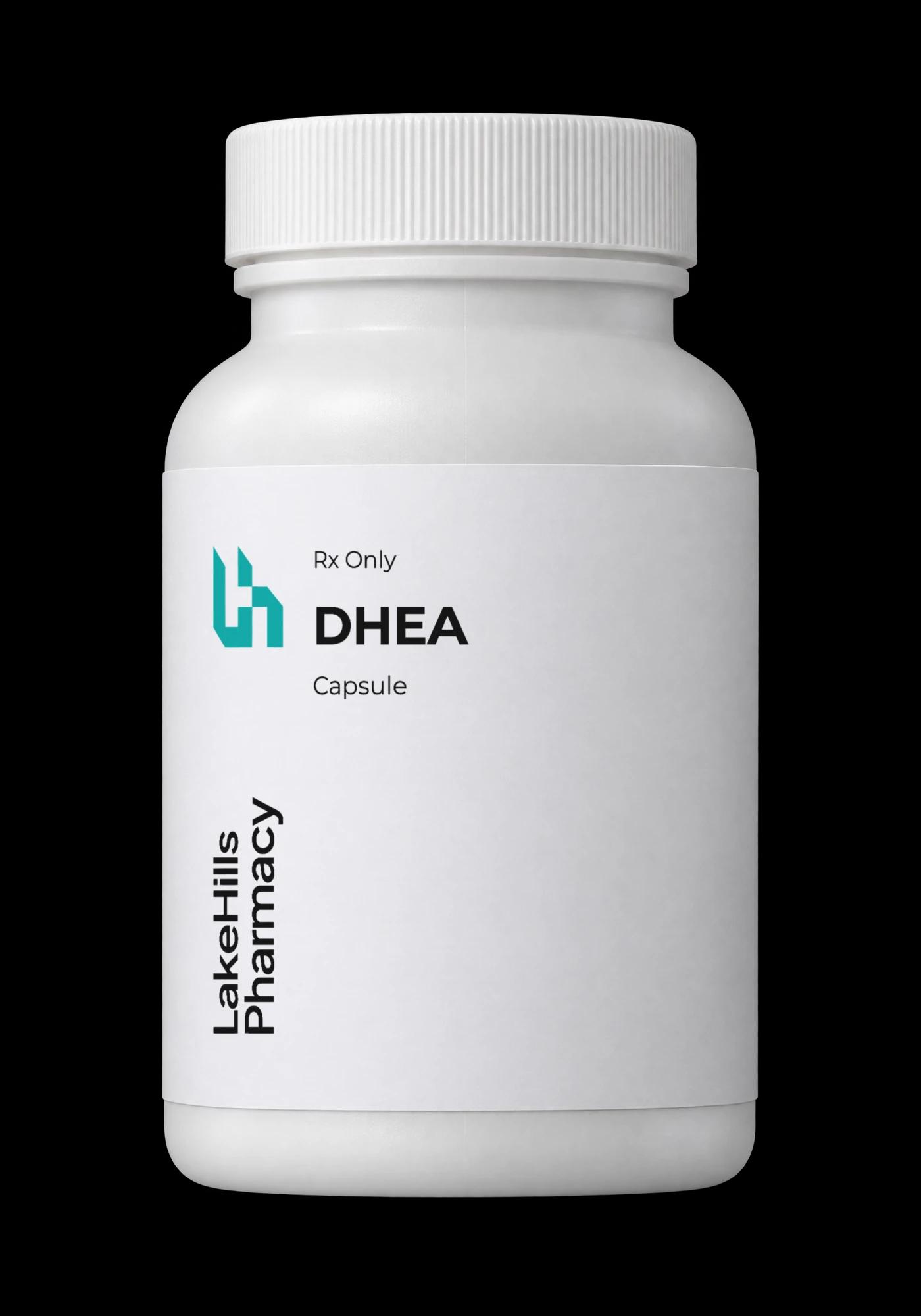
- Active ingredients
- Dosage form
- Capsule
- Route
- Oral
- Care area
- Drug class
- Adrenal / DHEA
- DEA schedule
- Non-controlled
- Storage
- Room temperature


Compounded and dispensed by an NABP-accredited, LegitScript-certified pharmacy. Verify accreditation (opens in a new tab)
About compounded medications
All formulations are patient-specific prescriptions compounded by Lake Hills Pharmacy under FDA section 503A. Individual ingredients are FDA-approved; compounded products are not reviewed by the FDA for safety, effectiveness, or quality. For licensed healthcare providers only.
Available Dosage Strengths
Capsule
5 mg
10 mg
25 mg
Clinical information
Product Overview
DHEA (Prasterone) Capsules are nonsterile oral capsules of dehydroepiandrosterone compounded by Lake Hills Pharmacy, a 503A pharmacy, pursuant to a patient-specific prescription. DHEA is an adrenal steroid that peripheral tissues convert to androgens and estrogens.
The only FDA-approved prasterone product, Intrarosa (prasterone) vaginal insert, is indicated for moderate to severe dyspareunia, a symptom of vulvar and vaginal atrophy, due to menopause. No oral prasterone product is FDA approved. Prescribers use compounded oral DHEA for individualized hormone therapy in men and women, such as in patients with low DHEA-S levels.
Active Ingredients & Strengths
Active ingredient: DHEA (prasterone).
Available strengths: 5 mg, 10 mg and 25 mg capsules, dispensed by the capsule in the quantity on the prescription. The 10 mg and 25 mg capsules are made in a hypromellose (Methocel E4M) sustained-release base; the release type of the 5 mg capsule is per the prescription label.
Dosing & Administration
Route: oral. Use as prescribed. No FDA-labeled dose exists for this route; dosing is individualized by the prescriber and guided by DHEA-S and sex-hormone levels. The labeled dose of the vaginal prasterone insert does not apply to oral use.
Key Safety Information
- Avoid in patients with known or suspected hormone-sensitive cancer (breast, uterine, ovarian or prostate), in pregnancy and breastfeeding, and with hypersensitivity. Evaluate undiagnosed abnormal genital bleeding before use.
- Androgenic effects include acne, oily skin, hirsutism, scalp hair loss and, in women, voice deepening, which may not reverse. Estrogenic effects such as breast tenderness or gynecomastia can occur.
- DHEA can lower HDL cholesterol. Irritability, insomnia and, rarely, mania have been reported, particularly in patients with mood disorders.
- Interactions: additive effects with estrogens, testosterone and other hormones. Aromatase inhibitors such as anastrozole reduce conversion of DHEA to estrogens; some prescriptions combine them intentionally, with hormone monitoring. Avoid with hormonal cancer therapy.
- DHEA is prohibited in competitive sport by the World Anti-Doping Agency.
Storage, Stability & BUD
Storage: room temperature.
Beyond-use date: per the prescription label.
USP default BUD for this dosage form: 180 days at controlled room temperature (USP <795>, nonsterile solid dosage form).
Lake Hills may assign extended dating based on its own stability data.
Patient Counseling
- Take DHEA exactly as your prescriber directs. Swallow sustained-release capsules whole; do not open or crush them unless your prescriber or pharmacist tells you to.
- Tell your prescriber about acne, unwanted hair growth, hair thinning, voice changes, breast changes, or changes in mood or sleep.
- Tell your prescriber about all hormone products and supplements you take. Do not use DHEA if you are pregnant or breastfeeding.
- Keep your laboratory appointments. Store the capsules at room temperature and discard them after the beyond-use date.
References
- Intrarosa (prasterone) vaginal inserts Prescribing Information.
- Diagnosis and Treatment of Primary Adrenal Insufficiency: An Endocrine Society Clinical Practice Guideline.
- USP General Chapter <795> Pharmaceutical Compounding: Nonsterile Preparations.
Active ingredients
DHEA (Dehydroepiandrosterone)
Adrenal / DHEA
Overview
Dehydroepiandrosterone (DHEA; drug name prasterone) is an endogenous C19 steroid secreted mainly by the adrenal cortex and circulating largely as DHEA sulfate (DHEA-S). It is a precursor of androgens and estrogens. The only FDA-approved prasterone product is Intrarosa, a 6.5 mg vaginal insert. No oral prasterone product is FDA approved; compounded oral preparations are made pursuant to patient-specific prescriptions. DHEA is excluded from the federal definition of anabolic steroids and is not a controlled substance.
Indications & Uses
FDA-labeled indication (Intrarosa, vaginal): moderate to severe dyspareunia, a symptom of vulvar and vaginal atrophy, due to menopause.
Prescribers use oral DHEA for individualized hormone therapy, including low DHEA-S levels with age, women with adrenal insufficiency who have low libido or reduced well-being despite glucocorticoid and mineralocorticoid replacement (a use addressed in Endocrine Society guidance), and as an adjunct in some fertility care. Lake Hills also prepares DHEA with anastrozole or clomiphene on prescription.
Mechanism of Action
DHEA is converted within peripheral tissues by 3-beta-hydroxysteroid dehydrogenase, 17-beta-hydroxysteroid dehydrogenase, 5-alpha-reductase and aromatase to androstenedione, testosterone, dihydrotestosterone and estradiol, which act on androgen and estrogen receptors locally. DHEA and DHEA-S also act as neurosteroids, modulating GABA-A, NMDA and sigma-1 receptors.
Pharmacokinetics
Oral DHEA is absorbed and undergoes extensive first-pass sulfation to DHEA-S. DHEA itself has a short half-life (under an hour), while DHEA-S circulates far longer (roughly 10 to 20 hours) and serves as a reservoir. Endogenous levels peak in early adulthood and decline with age. After oral dosing, women generally show larger rises in testosterone than men, whose conversion favors estrogens. Sustained-release bases are used to moderate peak levels.
Contraindications
- Undiagnosed abnormal genital bleeding (prasterone label).
- Known or suspected hormone-sensitive malignancy, such as breast, endometrial, ovarian or prostate cancer.
- Pregnancy and breastfeeding.
- Hypersensitivity to DHEA or any component.
Warnings & Precautions
- Hormone-sensitive tissues: estrogen is a metabolite of prasterone. Use in women with a current or past history of breast cancer has not been studied. In men, evaluate the prostate and PSA before and during therapy.
- Androgenic effects in women, including hirsutism, acne, scalp hair loss and voice deepening, can be irreversible; use caution in polycystic ovary syndrome and other hyperandrogenic states.
- DHEA can lower HDL cholesterol.
- Psychiatric effects: irritability, insomnia and, rarely, mania have been reported, particularly in patients with bipolar disorder or other mood disorders.
- Palpitations and arrhythmia have been reported rarely.
- DHEA is prohibited in competitive sport by the World Anti-Doping Agency.
Drug Interactions
- Estrogens, progestins, testosterone and other androgens: additive hormonal effects; adjust and monitor.
- Aromatase inhibitors such as anastrozole reduce conversion of DHEA to estrogens. They are combined intentionally in some prescriptions, with monitoring of estradiol and testosterone.
- Hormonal cancer therapies (for example tamoxifen or aromatase inhibitors for breast cancer, androgen deprivation for prostate cancer): DHEA may counteract them and is avoided.
- 5-alpha-reductase inhibitors reduce conversion of DHEA-derived testosterone to DHT.
Adverse Effects
Acne, oily skin, hirsutism, scalp hair thinning, voice deepening, menstrual irregularity, breast tenderness, gynecomastia in men, decreased HDL cholesterol, insomnia, irritability, mood elevation, headache, fatigue and palpitations. With the vaginal insert, vaginal discharge and abnormal Pap smear findings were reported.
Pregnancy & Lactation
DHEA is not used in pregnancy, because androgenic and estrogenic metabolites could affect fetal development. No lactation data exist, and it is not used during breastfeeding. Intrarosa is indicated only for postmenopausal women.
Monitoring
Baseline and periodic DHEA-S, with testosterone and estradiol as relevant; lipids; PSA and prostate assessment in men; signs of androgen excess in women; mood and sleep; and routine breast and endometrial evaluation in women per standard care.
References
- Intrarosa (prasterone) vaginal inserts Prescribing Information.
- Diagnosis and Treatment of Primary Adrenal Insufficiency: An Endocrine Society Clinical Practice Guideline.
- AHFS Drug Information. American Society of Health-System Pharmacists.
Ask a pharmacist
Are compounded medications FDA approved?
All formulations are patient-specific prescriptions compounded by Lake Hills Pharmacy under FDA section 503A. Individual ingredients are FDA-approved; compounded products are not reviewed by the FDA for safety, effectiveness, or quality. For licensed healthcare providers only.
How do I get a prescription filled here?
You can have your doctor send prescriptions to us any time. We also transfer your medications from another pharmacy. Our pharmacy accepts all major insurance plans.
Can you ship this medication to my state?
It depends on the medication and on your state. Whether we can dispense or ship a medication to you depends on the laws and board of pharmacy rules of your state and on our licensure there. We confirm availability when we receive a prescription.
These answers cover the basics. For anything about a formula, a strength or a prescription, contact our pharmacists.
Mon - Fri: 8:30am - 6:30pm CTSaturday: 9:00am - 2:00pm CTSunday: Closed
12005 Bee Cave Rd, Suite 1-A, Austin, TX 78738