
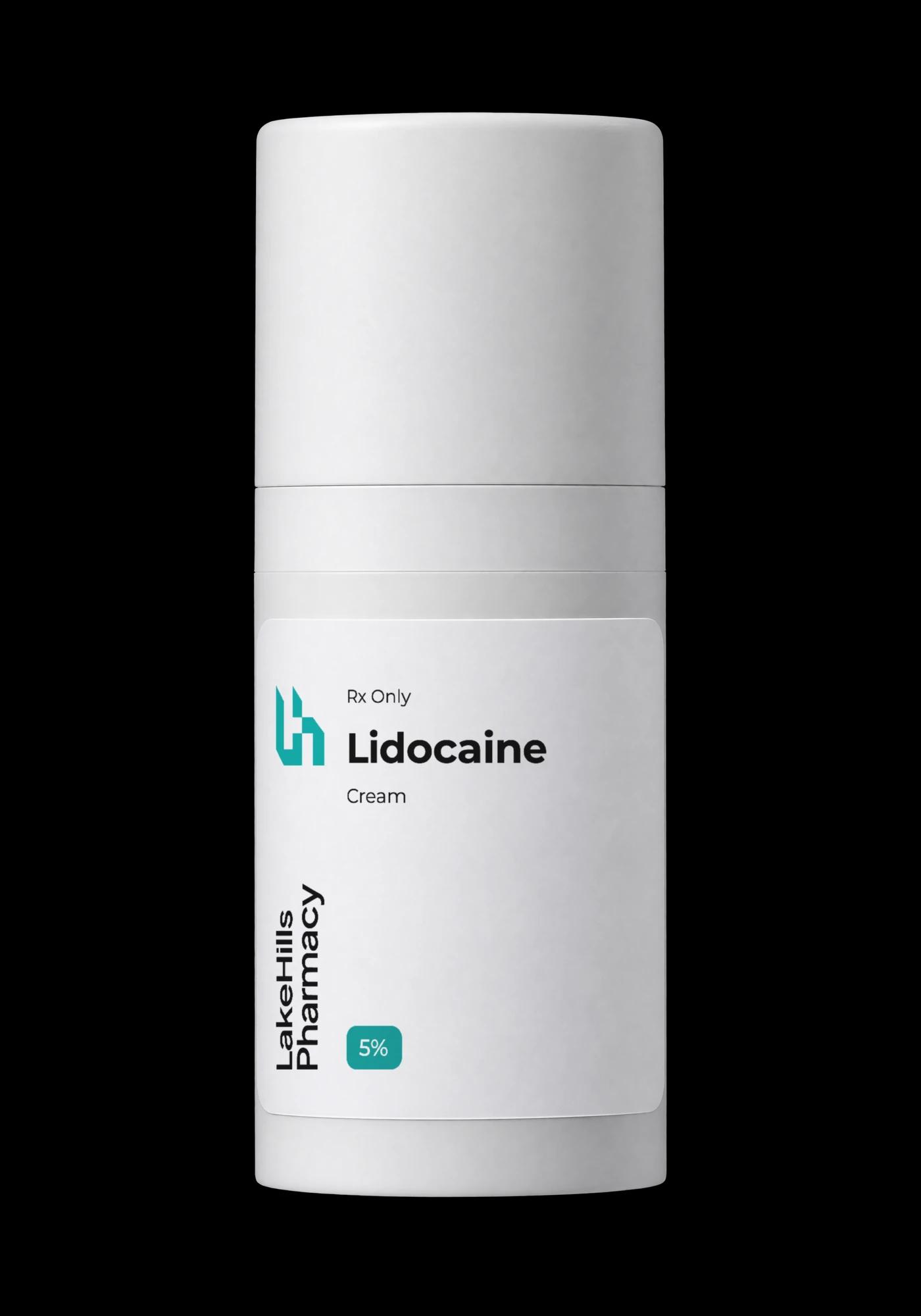
- Active ingredients
- Dosage form
- Cream
- Route
- Topical
- Care area
- Drug class
- Anesthetic
- DEA schedule
- Non-controlled


Compounded and dispensed by an NABP-accredited, LegitScript-certified pharmacy. Verify accreditation (opens in a new tab)
About compounded medications
All formulations are patient-specific prescriptions compounded by Lake Hills Pharmacy under FDA section 503A. Individual ingredients are FDA-approved; compounded products are not reviewed by the FDA for safety, effectiveness, or quality. For licensed healthcare providers only.
Available Dosage Strengths
Cream
5%
Unit size: 30 g
Clinical information
Boxed Warning
Lidocaine Hydrochloride Oral Topical Solution USP 2% (viscous): seizures, cardiopulmonary arrest and death have been reported in children under 3 years when it was not used in strict adherence to the dosing recommendations. It should generally not be used for teething pain; in children under 3 years, use is limited to situations where safer alternatives are not available or have failed. Caregivers should follow the prescribed dose and frequency exactly and store the bottle out of reach of children. Other lidocaine products do not carry a boxed warning.
Product Overview
Lidocaine 5% Cream (Lipoderm) is a nonsterile topical cream of lidocaine, an amide-type local anesthetic, in Lipoderm (a PCCA base; Lipoderm is a trademark of PCCA). Lake Hills Pharmacy compounds the preparation as a 503A pharmacy, pursuant to a patient-specific prescription.
Topical lidocaine reference products include lidocaine ointment 5%, labeled for anesthesia of accessible mucous membranes of the oropharynx and temporary relief of pain from minor burns, abrasions and insect bites, and the lidocaine 5% patch (Lidoderm), labeled for postherpetic neuralgia. Prescribers use compounded lidocaine cream for localized topical anesthesia or analgesia of intact skin.
Active Ingredients & Strengths
- Lidocaine 5% in Lipoderm base, 30 g.
Dosing & Administration
Route: topical, applied as prescribed to the smallest area needed. The prescriber sets the amount, area and frequency.
For reference, lidocaine ointment 5% labeling limits a single application in healthy adults to 5 g (250 mg lidocaine) and total use to about 17 to 20 g in one day; lower amounts apply to children, the elderly, debilitated patients and those with hepatic impairment. Lipoderm is designed to enhance skin penetration, so these figures are reference points, not an equivalence.
Apply to intact skin. Avoid the eyes, open wounds and large areas. Do not cover with occlusive dressings or apply heat unless the prescriber directs; both increase systemic absorption.
Key Safety Information
- Contraindicated with hypersensitivity to amide-type local anesthetics or any component of the base.
- Systemic toxicity: FDA has warned that topical anesthetics applied to large areas, under occlusion or with heat have caused seizures, irregular heartbeat and death. Early signs include dizziness, tinnitus, perioral numbness, metallic taste, confusion and drowsiness.
- Methemoglobinemia: risk is higher with G6PD deficiency, congenital methemoglobinemia, infants under 6 months and concurrent oxidizing drugs. Watch for gray or blue skin, headache, shortness of breath and fatigue.
- Interactions: additive toxicity with class I antiarrhythmics (such as mexiletine) and other local anesthetics; methemoglobinemia risk with nitrates, dapsone, sulfonamides and other oxidizing agents.
- Use caution in patients with severe hepatic disease, heart block or other conduction disorders, as these increase the risk from systemic exposure.
- Common adverse effects are local: erythema, burning, itching, edema and skin irritation at the site.
Storage, Stability & BUD
Storage: controlled room temperature, 20–25°C (68–77°F). Do not freeze. Keep the container tightly closed.
Beyond-use date: per the prescription label.
USP default BUD (USP <795>): 35 days at controlled room temperature or refrigerated for a preserved aqueous preparation, 14 days refrigerated for a nonpreserved aqueous preparation, or 90 days for a nonaqueous preparation; the category follows the Lake Hills base and vehicle. Lipoderm is a water-containing emulsion base.
Lake Hills may assign extended dating based on its own stability data.
Patient Counseling
Use this medication exactly as your prescriber directs. Do not change the dose, how often you use it, or stop it without talking to your prescriber. Apply only the amount prescribed, only to the area prescribed, and only to unbroken skin.
Do not cover the area with plastic or tight bandages, or use heating pads, unless your prescriber tells you to. Wash your hands after use, unless the hands are the treated area, and keep the cream away from your eyes.
The treated skin will feel numb; protect it from injury, heat and cold. Keep the cream out of reach of children and pets.
Stop using it and get medical help right away for dizziness, ringing in the ears, a metallic taste, confusion, blurred vision, irregular heartbeat, seizures, or gray or blue lips or skin. Report rash, swelling or severe irritation.
References
- Lidocaine Ointment USP, 5% Prescribing Information.
- Lidoderm (lidocaine patch 5%) Prescribing Information.
- USP General Chapter <795> Pharmaceutical Compounding—Nonsterile Preparations.
Active ingredients
Lidocaine
Anesthetic
Overview
Lidocaine is an amide local anesthetic and a class IB antiarrhythmic. US products include Xylocaine and generic injections (infiltration, nerve block, epidural and intravenous antiarrhythmic use) and many topical forms: 5% ointment, 4% solution, 2% jelly, 2% viscous oral solution, Lidoderm 5% patch, ZTlido 1.8% patch, and combinations such as EMLA (lidocaine/prilocaine) and Pliaglis (lidocaine/tetracaine). Lake Hills Pharmacy uses lidocaine in compounded topical anesthetic preparations.
Indications & Uses
- Injection: local or regional anesthesia by infiltration, peripheral nerve block and epidural techniques; intravenous treatment of ventricular arrhythmias.
- Lidoderm and ZTlido patches: relief of pain associated with postherpetic neuralgia.
- Topical ointment, solution and jelly: anesthesia of accessible mucous membranes and of the urethra, and relief of pain from minor burns and skin irritation.
- EMLA and Pliaglis: dermal anesthesia or analgesia on intact skin before superficial procedures.
- Prescribers use lidocaine in compounded topical anesthetic creams for procedural skin anesthesia and for localized pain.
Mechanism of Action
Lidocaine blocks voltage-gated sodium channels, binding preferentially to the inactivated state, which stabilizes neuronal membranes and blocks initiation and conduction of nerve impulses. In the heart it shortens the action potential duration in Purkinje fibers and suppresses ventricular automaticity.
Pharmacokinetics
Systemic absorption depends on dose, site, area treated, contact time, skin integrity, vascularity, heat and occlusion; it is low through intact skin and high through mucous membranes. Lidocaine is 60 to 80% protein bound, mainly to alpha-1-acid glycoprotein. It is metabolized in the liver by CYP1A2 and CYP3A4 to the active metabolites monoethylglycinexylidide and glycinexylidide; less than 10% is excreted unchanged. The half-life is about 1.5 to 2 hours and is prolonged in hepatic impairment and heart failure.
Contraindications
- Hypersensitivity to lidocaine, other amide-type local anesthetics or any component.
- Intravenous antiarrhythmic use: Stokes-Adams syndrome, Wolff-Parkinson-White syndrome, and severe sinoatrial, atrioventricular or intraventricular block without a pacemaker.
Warnings & Precautions
- Methemoglobinemia: reported with local anesthetics; risk is higher with G6PD deficiency, congenital methemoglobinemia, cardiac or pulmonary compromise, infants under 6 months, and concurrent oxidizing drugs.
- Systemic toxicity: CNS effects (lightheadedness, perioral numbness, tinnitus, confusion, tremor, seizures, respiratory depression) and cardiovascular effects (bradycardia, hypotension, arrhythmia, cardiac arrest).
- Topical use over large areas, for long periods, on broken skin, with heat or under occlusion increases absorption; FDA has warned of seizures and deaths with compounded topical anesthetics used this way.
- Use caution in hepatic impairment, heart failure, debilitated or elderly patients, and in patients with conduction disorders. Avoid the eyes.
Drug Interactions
- Class I antiarrhythmics (such as mexiletine) and other local anesthetics: additive toxicity.
- CYP1A2 inhibitors (fluvoxamine, ciprofloxacin), CYP3A4 inhibitors (erythromycin, itraconazole), amiodarone, cimetidine and beta-blockers such as propranolol: raise lidocaine levels.
- Methemoglobin-inducing drugs (dapsone, nitrates and nitrites, sulfonamides, primaquine, nitrofurantoin): increased methemoglobinemia risk.
- Class III antiarrhythmics such as amiodarone: additive cardiac effects.
Adverse Effects
Topical: erythema, edema, blanching, burning, itching and contact dermatitis. Systemic: dizziness, drowsiness, paresthesia, tinnitus, blurred vision, tremor, seizures, bradycardia, hypotension, arrhythmia and, rarely, methemoglobinemia or anaphylaxis.
Pregnancy & Lactation
Lidocaine crosses the placenta and has been used widely in obstetric anesthesia without evidence of teratogenicity at clinical exposures. Small amounts pass into breast milk and are poorly absorbed orally by the infant, so topical use during breastfeeding is generally considered compatible.
Monitoring
With high-strength or large-area topical use: early signs of systemic toxicity (perioral numbness, tinnitus, dizziness, confusion, arrhythmia), pulse oximetry and co-oximetry if methemoglobinemia is suspected, and adherence to the prescribed amount, area and time. With intravenous use: ECG, blood pressure and CNS status.
References
- Xylocaine (lidocaine HCl) Injection Prescribing Information, Fresenius Kabi.
- Lidoderm (lidocaine patch 5%) Prescribing Information.
- Lidocaine Hydrochloride Oral Topical Solution USP 2% (viscous) prescribing information.
- FDA Drug Safety Communication: risk of methemoglobinemia with benzocaine and other local anesthetics (2018).
- FDA Public Health Advisory: life-threatening side effects with skin numbing products used for cosmetic procedures (2009).
Ask a pharmacist
Are compounded medications FDA approved?
All formulations are patient-specific prescriptions compounded by Lake Hills Pharmacy under FDA section 503A. Individual ingredients are FDA-approved; compounded products are not reviewed by the FDA for safety, effectiveness, or quality. For licensed healthcare providers only.
How do I get a prescription filled here?
You can have your doctor send prescriptions to us any time. We also transfer your medications from another pharmacy. Our pharmacy accepts all major insurance plans.
Can you ship this medication to my state?
It depends on the medication and on your state. Whether we can dispense or ship a medication to you depends on the laws and board of pharmacy rules of your state and on our licensure there. We confirm availability when we receive a prescription.
These answers cover the basics. For anything about a formula, a strength or a prescription, contact our pharmacists.
Mon - Fri: 8:30am - 6:30pm CTSaturday: 9:00am - 2:00pm CTSunday: Closed
12005 Bee Cave Rd, Suite 1-A, Austin, TX 78738